“Christmas blend” is a marketing category, not a coffee category. Nothing about the phrase is regulated or even loosely defined. A roaster can take its everyday house blend, push the roast two notches past where it wanted to stop, print a red bag, and sell it as seasonal. A great many of them do precisely that.
That matters more for us than for most drinkers, because a cone filter is an honest instrument. Drip machines and French presses will hide a coffee that has been roasted into submission. A V60 will not. It hands you the ash, the flatness, and the papery finish in full detail. So the question is not which holiday bag is the most festive — it is which ones survive contact with a pour-over.
The three kinds of holiday blend
Sort every red bag on Amazon into one of three buckets and the category stops being confusing. First, the dark comfort blends: roasted heavy and low-acid on purpose, engineered to stand up to cream, eggnog, and a pump of syrup without disappearing. Second, the origin-forward seasonal blends: the roaster picks coffees whose natural character reads as wintry — cocoa, dried fruit, warm baking spice — and roasts each component to fit, with nothing added. Third, flavored coffee, where the seasonal part is an oil applied after roasting.
Pour-over rewards the second group, tolerates the first with adjustments, and actively fights the third. All three are represented below, and I have been clear about which is which.
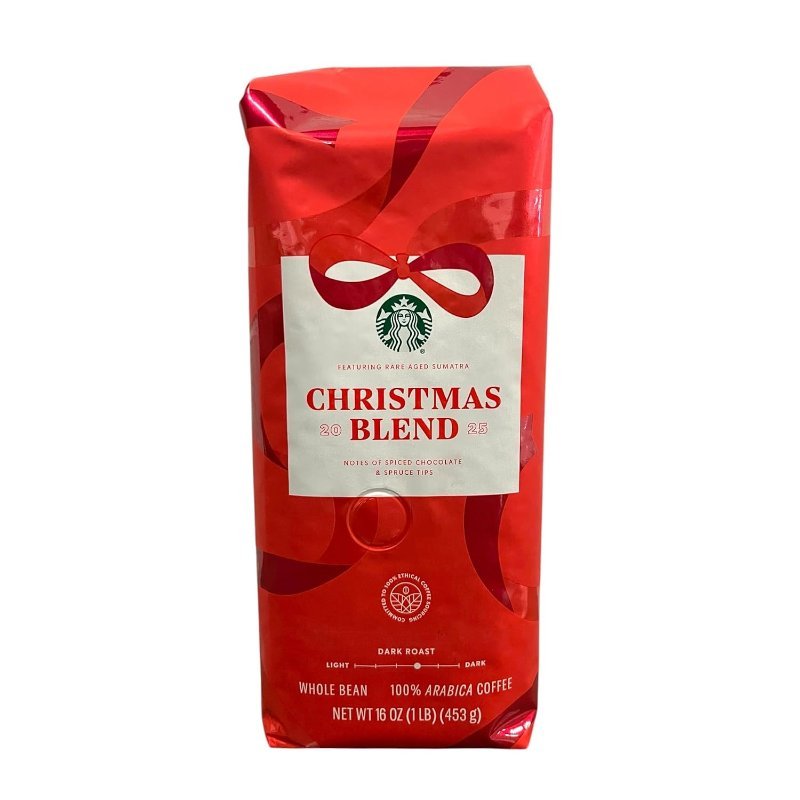
The benchmark: Christmas Blend is back on the shelf for the season
You can be snobbish about Starbucks and still owe this bag some respect. It launched the day after Thanksgiving in 1984, when Starbucks was five Seattle storefronts selling beans, teas, and spices and nothing else — no lattes, no green aprons on every corner. The formula has stayed recognizable ever since: lively Latin American coffees, mellower Indonesians, and the part that actually makes it interesting, a slug of aged Sumatra.
That aging is not a marketing flourish. Green Sumatra beans are bought at harvest peak, shipped to Singapore, and left to rest for three to five years in that climate, tasted periodically until the team decides they are ready. Aging strips out brightness and pushes a coffee toward cedar, leather, and deep baking spice — which is why the finished blend tastes like spiced chocolate with a resinous, almost spruce-like edge rather than like the Guatemalan and Colombian components on their own. Current bags are a dark roast, and the current 40-plus-year run makes this the closest thing the category has to a fixed point.
An October update, and a welcome one: the listing is live again — in stock, shipped by Amazon, $29.99 for the 16-ounce whole-bean bag. The holiday run opened early this year. The Holiday Blend bag that stood in here through September has since gone temporarily out of stock in whole bean, so the two have traded places, and in the right direction. Buy this one while the season is open; dated seasonal SKUs do not come back on a schedule you can plan around.
Some links on this page are Amazon affiliate links, which means I earn a commission if you buy through them, at no extra cost to you.
Starbucks Christmas Blend, Whole Bean, Dark Roast, 16 oz
The aged-Sumatra blend that started the category in 1984, and the only bag here with a story worth telling while it brews. Spiced chocolate with a resinous, almost spruce-like edge. It is a dark roast, so drop your water to 198–200°F and go a click or two coarser than usual.
The light-roast slot: Christmas Blonde is gone, and so is Veranda’s buy box
The pick that lived here was the Starbucks Christmas Blonde Roast — a light roast built on washed Ethiopian beans with Asia/Pacific coffees underneath, and the one bag on this list I would put in a cone without touching my recipe. It is now unavailable on Amazon with no restock date, which is the ordinary fate of a dated seasonal SKU once its season is over. Leaving a dead link up and describing a coffee you cannot buy would be worse than saying so.
Veranda Blend was the substitute here through September, on the reasoning that it is the same Starbucks blonde-roast profile sold year-round. The reasoning still holds. The listing does not: Amazon no longer sells the Veranda whole-bean bag itself, the page has lost its buy box entirely, and what is left is a column of third-party resellers starting around $25 for sixteen ounces, with Amazon’s own high-price warning attached. Pointing you at a page where the buy button has been replaced by a list of marketplace sellers is not a recommendation.
The blonde roast to buy instead is Starbucks Blonde Espresso Roast, in the 28-ounce whole-bean bag Amazon still stocks directly. The word espresso in the name describes the roast target, not a restriction on your brewer — it is a true blonde roast, Latin American and East African beans taken off early, with soft citrus and caramel sweetness, and it behaves in a cone the way any light roast does. At $25.64 for 28 ounces it works out to about ninety cents an ounce, which undercuts every Veranda bag this post has ever linked.
Brew it the way you would any light roast: 205°F, medium-fine grind, a full 45-second bloom, roughly 1:16. If what you want is specifically the seasonal character, the Christmas Blend above is the bag to buy — a dark roast, and not an equal on clarity.
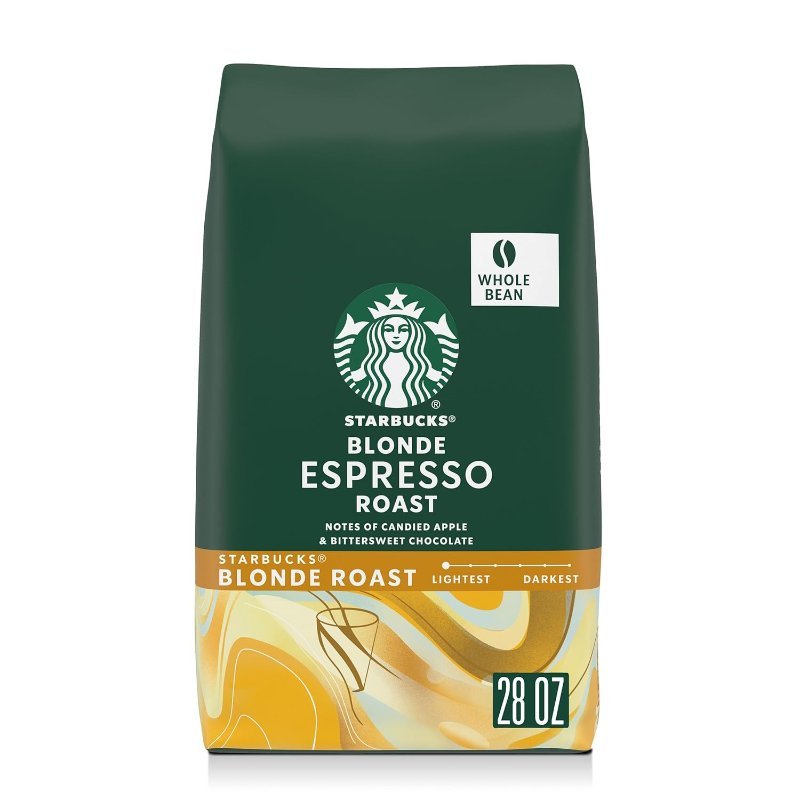
Starbucks Blonde Espresso Roast, Whole Bean, Light Roast, 28 oz
The blonde roast Amazon still sells itself, now that Veranda’s buy box is gone. Citrus and soft caramel, no red bag, no scarcity tax — and the cheapest per ounce of anything on this page.
The small-batch pick worth reading the bean list on: St. Nicholas
Most seasonal blends will not tell you what is in them. This one does: Fair Trade organic Peruvian, Ethiopian natural, and — the reason I bothered — Malawi AA. Malawi is a rounding error in world coffee production, and the good stuff comes out of the Misuku Hills in the far north, up against the Tanzanian border, where farms sit between roughly 1,700 and 2,300 meters. Most of it is grown by smallholders organized through the Mzuzu cooperative union, six co-ops covering something like 3,000 farming families who have been at this since the 1940s.
It is a medium roast, unflavored, with chocolate and roasted-chestnut character — seasonal by composition rather than by additive. That, plus a bean list you can verify, is more than most red bags on Amazon offer.
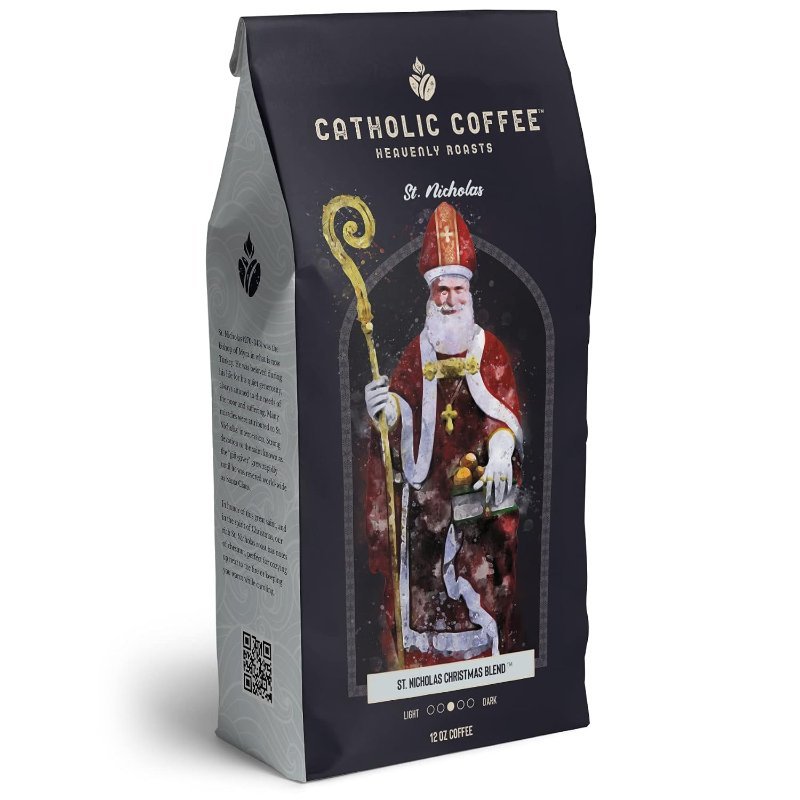
Catholic Coffee St. Nicholas, Whole Bean, 12 oz
A three-origin medium roast — Peru, Malawi AA, Ethiopian natural — with chocolate and chestnut notes and no added flavoring. The Malawi component is genuinely uncommon in a supermarket-priced blend.
If you want the flavored one, buy it on purpose
There is no shame in liking flavored coffee. There is some shame in pretending it is something else. Barnie’s Santa’s White Christmas is a medium roast carrying coconut, caramel, and vanilla, naturally and artificially flavored, and it is the best-known bag in this corner of the category for a reason — it tastes like the thing it is advertising.
Two practical warnings. Flavoring oils cling to burrs and stay there, so anything you grind afterward will carry a ghost of coconut for days; if you own one grinder and care about your single origins, grind this one last or not at all. And skip the cone — flavored coffee does better in a French press or a drip basket, where you are not trying to resolve delicate acidity anyway. Treat it as dessert and it delivers.
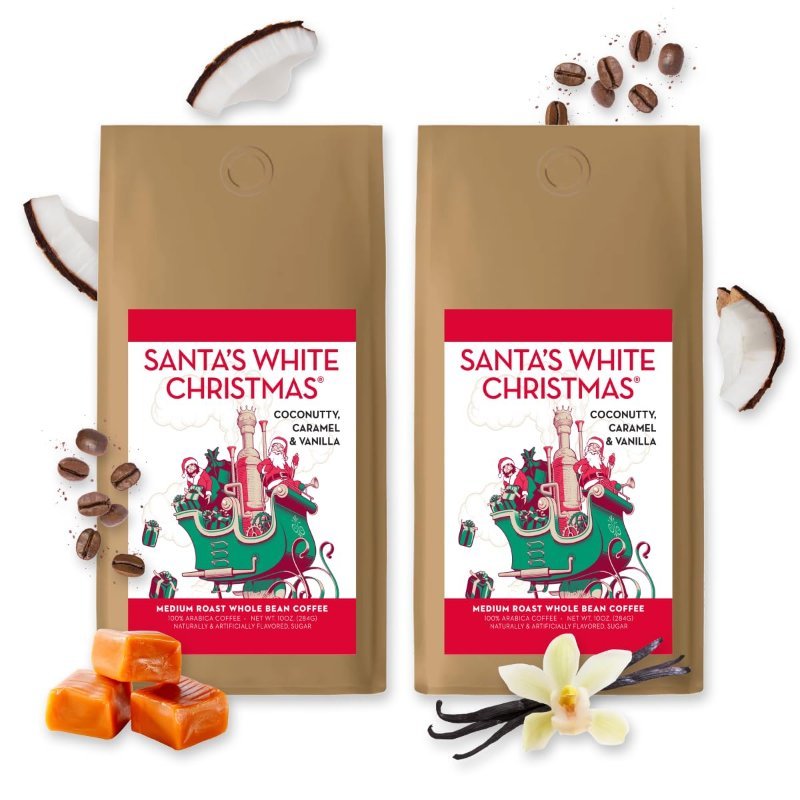
Barnie’s Santa’s White Christmas, Whole Bean
Coconut, caramel, and vanilla over a medium-roast arabica base, sold as a two-bag pack. Unapologetically a flavored coffee. Keep it away from your good grinder.
How to brew a dark holiday blend without it tasting like an ashtray
Dark roasts are more soluble — the roast has already done part of the work of breaking the bean down — so the same recipe that nails a light Ethiopian will over-extract them into bitterness. Three adjustments fix most of it. Drop your water to 198–200°F. Go one or two clicks coarser than your usual pour-over setting. And pour gently, with less agitation and a shorter total brew time, targeting around 1:16 to 1:17. If it still tastes hollow, the problem is the roast, not you.
The short version
Christmas Blend is the one with a real story and an unusual aged component, and it is worth drinking once a year for that alone — it is back on Amazon now, so buy it while the season is open. Blonde Espresso Roast is what belongs in a cone, now that the Christmas Blonde is gone and the Veranda listing has lost its buy box. St. Nicholas is the one for people who read bean lists. Santa’s White Christmas is for when you want coffee-flavored dessert and are willing to say so out loud. Everything else in the red-bag aisle deserves a hard look at the roast level before your money leaves your hand.