If you have felt personally attacked at the grocery store lately, you are not imagining it. Coffee is one of the few things in the cart that has kept climbing while most of the rest of the food aisle has calmed down. The gap is not subtle, and the reasons behind it are more interesting than “inflation.”
The number that actually matters
The Bureau of Labor Statistics has tracked the average retail price of a pound of 100% ground roast coffee since 1980. In April 2026 that number hit $9.72 per pound — the highest reading in the history of the series. It edged out March’s $9.60, which had itself been a record. Since January 2025, that average has climbed roughly 39%.
May came in slightly cooler at $9.51 a pound, but that is still up about 20% from $7.93 a year earlier. For context, over the same April-to-April window the overall Consumer Price Index rose 3.8% and food-at-home rose 2.9%. The BLS coffee index rose 18.5%. Instant coffee, of all things, was the worst of the bunch at 22.8%.
So no, coffee is not simply riding the same wave as everything else. It is having its own private crisis.
What the futures market is doing
Retail prices are downstream of the ICE arabica contract, and that contract has been ugly for two years running. Arabica traded around $2.10 a pound in late 2023, spiked to roughly $4.10 in early 2025, and has spent 2026 refusing to settle down — it was still hovering in the $3.30s per pound at the end of July.
Two things are propping it up. First, inventory. ICE certified stocks have drained to about 274,000 bags, the lowest since early February 2024. When the exchange warehouses are thin, every bit of bad weather news gets priced in twice.
Second, Brazil is running late. Cooxupé, the country’s largest coffee cooperative, reported its farmers had brought in 58.3% of the 2026 crop as of July 24 — against 67.1% at the same point last year. The crop is not necessarily smaller, it is just arriving slower, and a market with no cushion reacts badly to waiting.
The tariff angle is smaller than the headlines suggest
This is where a lot of coverage gets sloppy. A 25% tariff on Brazilian goods took effect on July 22, 2026 — but coffee was on the exclusion list, alongside beef, orange juice, and aircraft parts. Green coffee already enters the U.S. at a 0% base duty. A separate 10% layer applied earlier in the cycle was scheduled to sunset in late July.
That does not mean tariffs never mattered. Costs incurred months ago are still working their way through roaster contracts and retail shelves. But if you are waiting for a tariff repeal to fix your grocery bill, that is not the lever. Supply is the lever.
Why your bag hasn’t gotten cheaper yet
Retail lags the commodity market badly — typically by two to three quarters. Roasters buy forward, often six to twelve months out, so the bag you picked up this week was likely priced against contracts signed when arabica was near its worst. When futures fall, your grocery store is the last place to find out.
Rabobank’s current call is that a 2026/27 production surplus of around 8.64 million bags will push arabica futures down by roughly a third by the fourth quarter of this year. If that holds, shelf prices should soften — but realistically not until well into 2027. Forecasts like this have a poor track record when stocks are this low, so hold it loosely.
What we’re actually buying while this plays out
The practical takeaway is unglamorous: buy whole bean, buy it in two-pound bags, and stop buying pre-ground. Here is the arbitrage nobody mentions — that record $9.72 figure describes commodity pre-ground coffee in a can. The premium you pay to step up to a decent whole-bean bulk bag has narrowed dramatically, because the cheap stuff rose faster than the good stuff. Trading up costs less than it did two years ago.
Some links below are affiliate links. If you buy through them we may earn a commission at no extra cost to you.
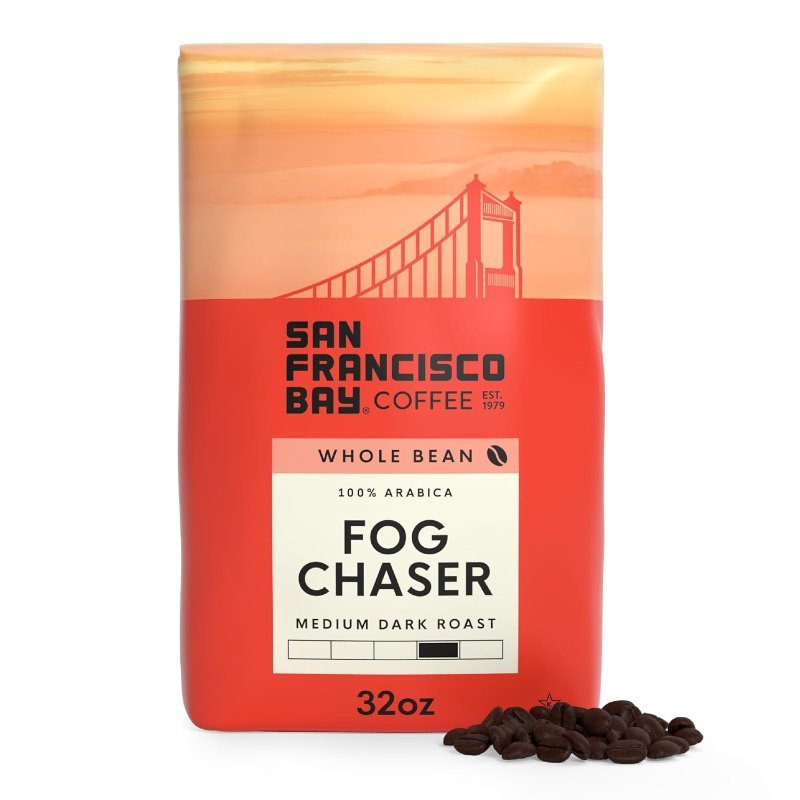
The bag we keep restocking is San Francisco Bay’s Fog Chaser. It is a medium-dark blend of dark and medium roasted arabica, it comes in a two-pound bag, and it is forgiving in a way that matters when beans are expensive — it does not punish you for a slightly sloppy pour or a grinder that is a click off. It is not a bright, delicate single origin and it is not pretending to be. It is the everyday bag, the one you brew on a Tuesday without thinking about it, and at two pounds the price per cup is hard to beat right now.
San Francisco Bay Coffee Fog Chaser, Whole Bean, 2 lb
Medium-dark, balanced, chocolate-and-toffee leaning. Buying it whole bean in a two-pound bag is the single easiest way to cut your cost per cup without drinking worse coffee.
One more thing worth doing while prices are high: stop wasting beans. Grinding immediately before brewing, keeping the bag sealed and away from heat, and dialing in your ratio instead of eyeballing it will stretch two pounds noticeably further than a careless routine will. At current prices, a kitchen scale pays for itself faster than it used to.
What to watch next
Three things will tell you where this goes: whether Brazil’s harvest pace catches up through August, whether ICE certified stocks start rebuilding off that 274,000-bag floor, and whether the projected 2026/27 surplus actually materializes. If all three break the right way, the pressure comes off the futures market this fall — and reaches your grocery aisle roughly two quarters after that.
Until then, buy bigger bags, grind fresh, and try not to look at the shelf tag.