The carafe is the least interesting piece of a pour-over setup and the one most likely to end the hobby for you by shattering on a tile floor at six in the morning. It gets skipped in gear roundups because it does not change flavor the way a grinder or a dripper does. That is true, and it is also not a reason to buy whatever glass vessel is cheapest.
Think about what the thing is actually being asked to do. Sit under a loaded dripper without tipping. Take near-boiling water hitting cold glass, twice a day, for years. Let you see the brew so you can stop at the right volume. Pour without dribbling down its own side. Survive several hundred trips through a sink. Flavor is not on that list. Thermal shock tolerance, stability, and legibility are, and those are the criteria I judged these on.
Borosilicate is not just a word on the box
Borosilicate glass has a coefficient of thermal expansion of about 3.3 × 10⁻⁶/K. Ordinary soda-lime glass, which is what most drinking vessels and a lot of no-name pour-over servers are made of, sits closer to 9 × 10⁻⁶/K. That gap is the whole ballgame. When you dump 205-degree water into a room-temperature carafe, the inner surface expands and the outer surface has not caught up yet, and the resulting stress is roughly proportional to that expansion number. Borosilicate shrugs. Soda-lime cracks, sometimes on the first pour, more often on the fortieth.
It is also non-porous, which is why lab glassware and every serious coffee server are made of it. Coffee oils sit on the surface instead of soaking in, so a carafe you clean properly does not slowly start tasting like every batch you have ever brewed in it.
The practical takeaway: if a product listing does not say borosilicate, assume it is not, and pass. The material costs a few dollars more to manufacture and every brand that uses it says so.
Buy for the batch you actually brew
The most common carafe mistake is not material, it is size. People buy the biggest server on the shelf because it seems more versatile, then brew 300ml into an 800ml vessel every morning and wonder why the coffee is lukewarm by the second sip. A large volume of cold glass and a large volume of air both pull heat out of a small brew fast. Match the carafe to your normal cup count and accept that the rare four-person morning is a second brew, not a bigger one.
The picks
These are affiliate links, so if you buy through one I get a small commission at no extra cost to you.
The one most people should buy
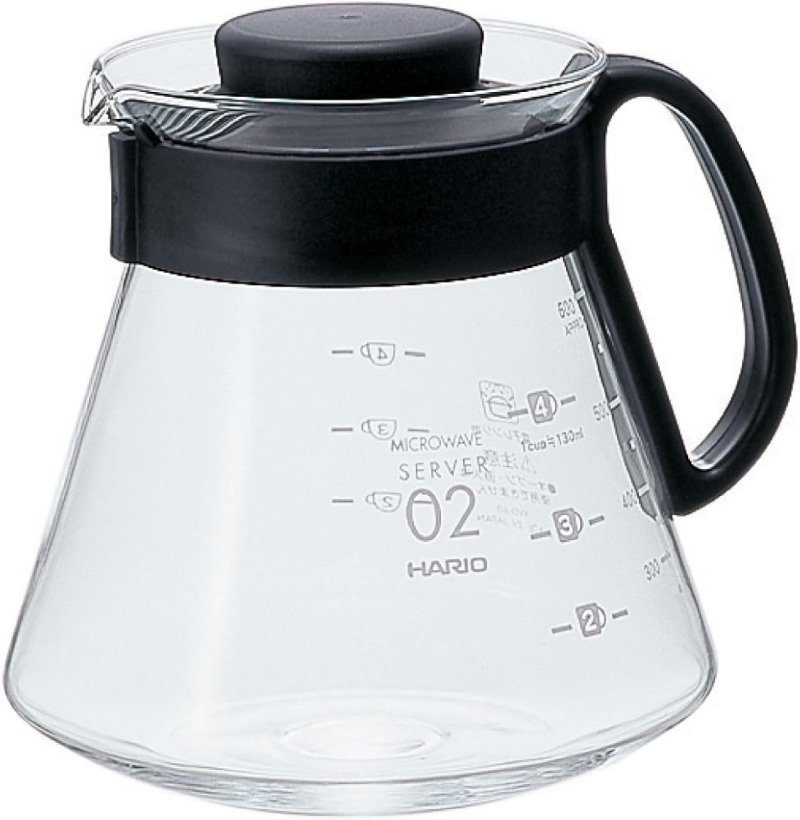
Hario has been making glass in Japan since 1921, and the V60 Range Server is the carafe you see under a dripper in more cafes than anything else. The 600ml version is the right size for one large mug or two modest ones, the tapered shape means the V60 cone seats on it without wobbling, and the wide mouth means you can actually get a hand and a sponge inside it. The polypropylene handle and lid keep the price down, which is the trade: it is not a heirloom object, it is a tool that costs about fifteen dollars and works. The glass body is microwave-safe if you are the kind of person who reheats, though I would rather you did not.
Hario V60 Glass Range Coffee Server, 600ml
Heatproof borosilicate body, polypropylene handle and lid, sized for one big mug or two small ones. The default answer.
If two full mugs is your normal
Same server, same glass, more room. The 800ml is the one to get if you brew for two people every morning rather than occasionally. It is barely more money, and the extra headroom means you are not watching the water line creep toward the rim on a 500ml brew. I would not go bigger than this in the Hario line unless you are serving a table, because past 800ml the heat-loss math starts working against you and a Chemex does the job better anyway.
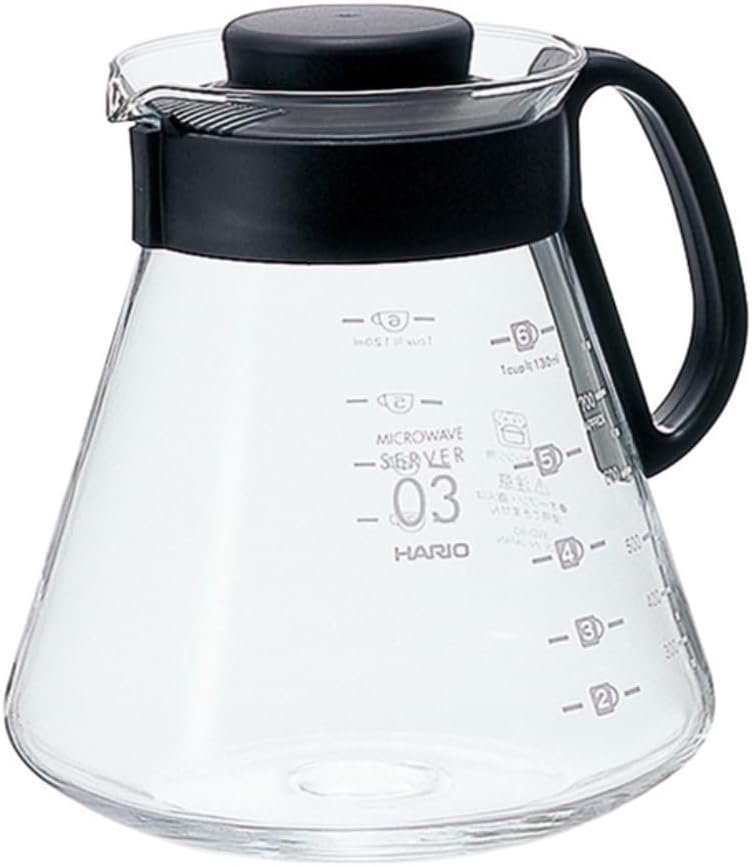
Hario V60 Glass Range Coffee Server, 800ml
The same carafe with a third more capacity. Get this one if two people drink coffee at your house every day.
The brewer and the carafe in one piece
Peter Schlumbohm patented the Chemex in 1941. He was a chemist, not a designer, and the shape is what happens when someone solves a brewing problem with an Erlenmeyer flask and a funnel. MoMA put one in its permanent collection two years later, and the form has not changed since. Chemex counts a cup as five ounces, so the 6-cup holds 30 ounces, which is a real pot of coffee rather than a personal serving.
What you are buying is a single piece of borosilicate glass that is both dripper and server, plus a filter thick enough to strip out essentially all the oil and fines. That last part is the actual decision. Chemex coffee is exceptionally clean and slightly thin compared with a V60 brew, and whether that reads as clarity or as missing something is a matter of taste. If you like your coffee tea-like and transparent, this is the best thirty-ounce object in the category. If you like body, buy the Hario and a metal-mesh-friendly dripper.
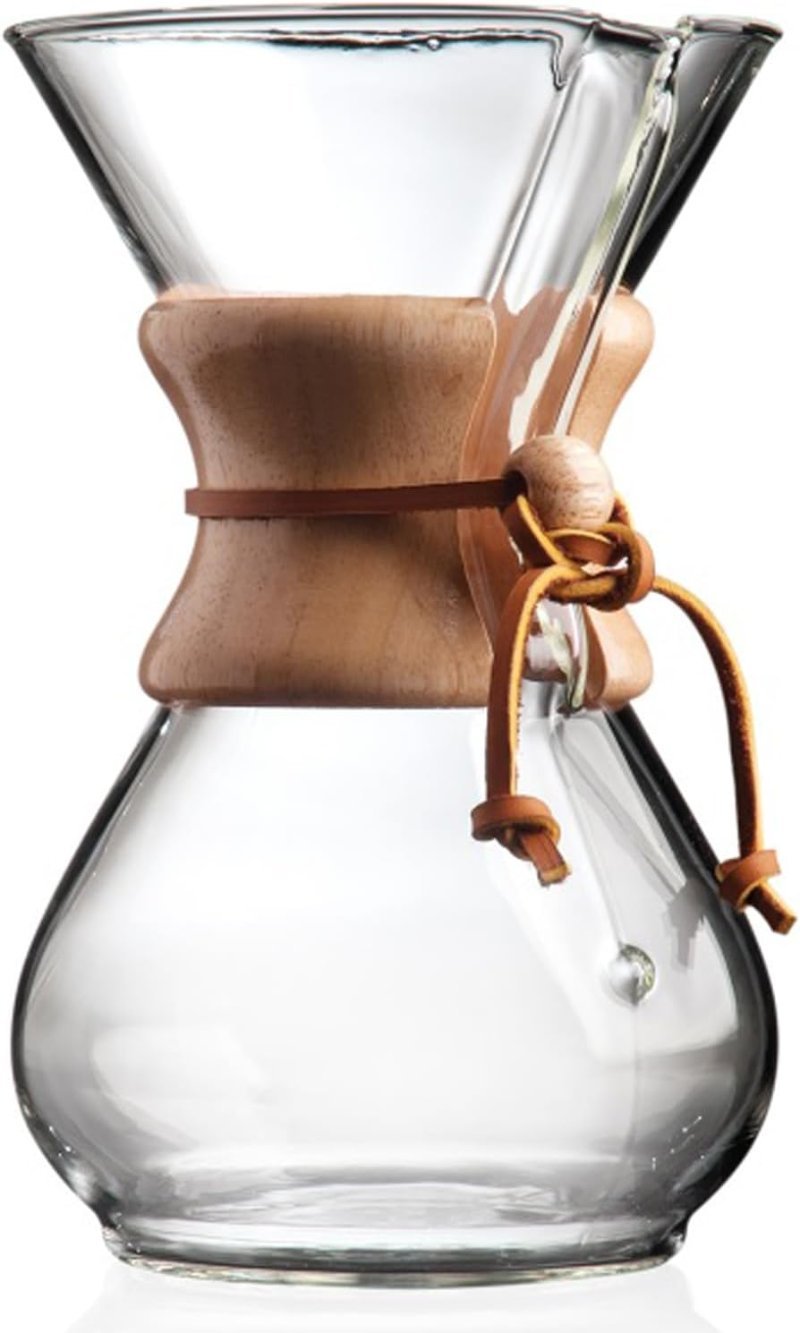
Chemex Pour-Over Glass Coffeemaker, Classic Series, 6-Cup
30 ounces of non-porous borosilicate, wood collar and leather tie, uses the thick bonded filters that make Chemex coffee taste like Chemex coffee. Filters sold separately.
The same Chemex, minus the part you will resent
The wood collar and leather tie on the Classic are the reason people photograph a Chemex, and also the reason cleaning one is annoying. The collar has to stay dry, which means no dishwasher and a certain amount of careful sink choreography every time. The Glass Handle Series solves this by making the handle out of the same borosilicate as the body, in one piece. It goes in the dishwasher. It costs the same. It is less pretty on a shelf and considerably less irritating in a kitchen, and I know which one I would still be using in five years.
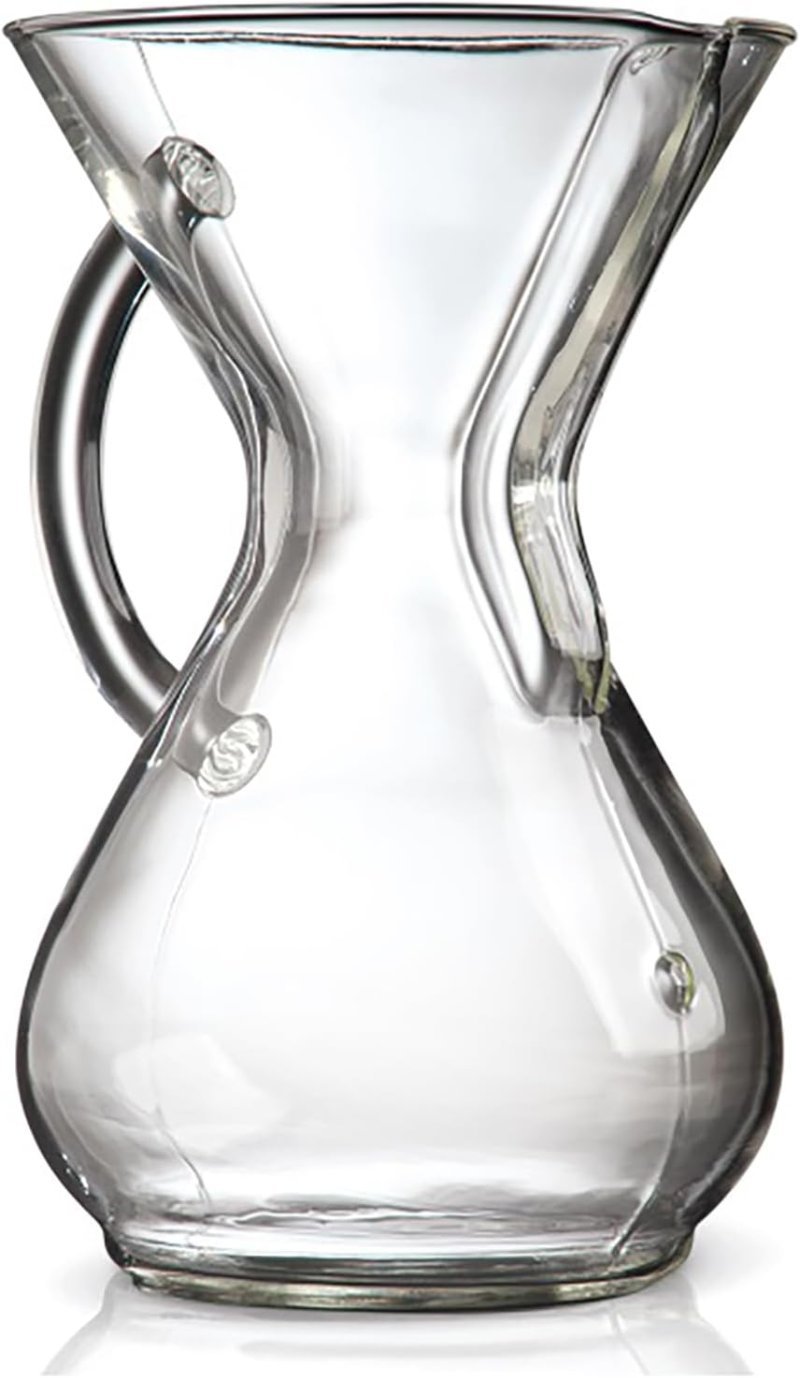
Chemex Pour-Over Glass Coffeemaker, Glass Handle Series, 6-Cup
Identical brewing, one continuous piece of glass, dishwasher-safe. The version I would actually own.
Keeping the glass from turning brown
Coffee oils build a film that dish soap does not touch. Once a week, soak the carafe in hot water with a percarbonate coffee cleaner, then rinse hard. What you should not do is attack it with an abrasive pad. Scouring borosilicate leaves micro-scratches, and micro-scratches are where thermal stress concentrates, which means the scrubbing you did to keep it looking new is what eventually breaks it. Also: let a hot carafe cool before it meets cold water. Borosilicate is resistant to thermal shock, not immune to it.
What I would skip
Double-walled glass servers look great and are a bad buy for pour-over. The insulation is real but marginal over the ten minutes it takes to drink the coffee, the gap between the walls is impossible to inspect, and when the seal eventually fails you get condensation trapped inside a vessel you cannot open. Skip anything sold without a stated glass type. And skip carafes with a narrow neck, whatever they are made of, because a sponge that will not fit is a carafe that will be brown by March.