Two bags sit on the shelf. One has a Fair Trade seal. The other says “direct trade” in nice type on the back. Most people read those as the same claim with different branding — one certified, one artisanal. They’re not the same claim. They’re barely the same category of claim, and understanding the difference changes which bag you should reach for.
Here’s the short version: Fair Trade is an enforceable floor with a low ceiling. Direct trade is an unenforceable promise with a very high ceiling. Whether the second is better than the first depends entirely on whether the roaster shows you their numbers.
What Fair Trade actually guarantees
Fairtrade International is a third-party certifier with an audit trail. When a co-op is certified, buyers must pay at least the Fairtrade Minimum Price regardless of where the commodity market sits. Effective December 1, 2026, that minimum rises to $2.00 per pound for washed Arabica — up 20 cents, an 11 percent increase over the previous $1.80. Natural Robusta goes to $1.30 per pound, up a dime. On top of the minimum sits the Fairtrade Premium of $0.20 per pound, which stays unchanged, plus a $0.40 organic differential for certified organic lots.
That Premium is the part people misunderstand. It doesn’t go into a farmer’s pocket as extra income. It goes to the co-operative, and the co-op’s members vote on how to spend it — a school, a health clinic, a shared depulping machine, sometimes a direct cash distribution. It’s a community fund with a democratic allocation requirement attached.
What Fair Trade does well is act as a safety net. When the C market collapses — and it does, on a cycle — certified farmers don’t fall through the floor. That’s a real, structural protection that no handshake agreement replicates.
Where the system runs out of road
The minimum price is quality-blind. A co-op producing a genuinely exceptional 88-point lot and one producing a serviceable 82-point lot both clear the same floor. Nothing in the certification rewards the farmer who took the risk of a slower harvest, a more careful ferment, or a varietal that yields less but cups better. If the goal is encouraging quality, a flat floor is a weak instrument.
Certification also costs money. Co-ops pay to get certified and pay to stay certified, and the model is built around smallholder co-operatives — which means individual estates and farms outside a co-op structure often can’t participate even when their practices are excellent.
What “direct trade” means: nothing, by default
This is the part worth being blunt about. There is no governing body for direct trade. No standard, no audit, no certification mark, no third-party verification. Any roaster can print the words on a bag after a single trip to a farm, or after buying through three intermediaries and calling one of them a partner. The term describes an intention, not a verified practice.
When it’s real, though, the ceiling is much higher than Fair Trade’s. A roaster negotiating directly can pay $3 to $5 per pound — or more — for a microlot, because they’re paying for cup quality rather than clearing a floor. That money goes to the producer rather than being split across a co-op’s membership, and the price signal actually rewards the thing you want rewarded.
The thing to actually look for
Ignore the phrase. Look for published numbers. A roaster serious about direct trade will tell you what they paid per pound, to whom, in what volume, in what year — and they’ll do it every year, not once in a press release. That’s a falsifiable claim. “Direct trade” on its own is not.
Some links below are affiliate links — if you buy through them, this site earns a commission at no extra cost to you.
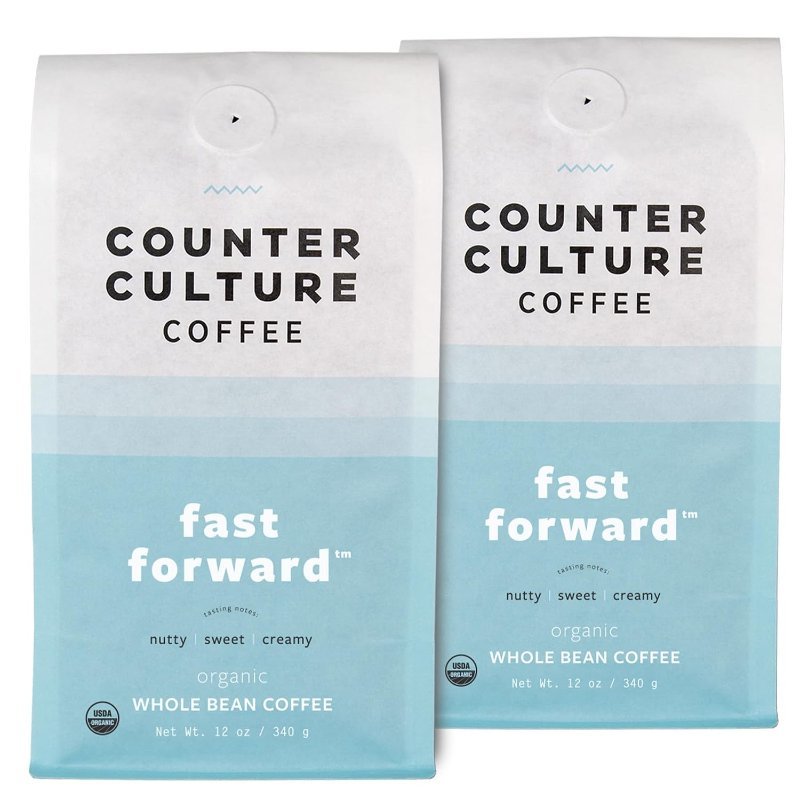
Counter Culture is the cleanest example of what that standard looks like in practice. They’ve published annual Transparency Reports since 2009 and started making their direct trade buying prices a matter of public record in 2010 — well before it was a marketing advantage. The numbers hold up: in their 2021 report they paid a $3.10 per pound weighted average FOB price while the C market average sat at $1.42. Their 2025 report puts weighted average FOB at $4.18 per pound across all coffees, $5.04 for single origins. They’re also B Corp certified, with a B Impact Assessment score of 91.9 as of 2024. Fast Forward, their light roast, is the easiest place to start — nutty and sweet, forgiving on a V60, and it comes as a two-pack, which is the right amount of coffee to actually finish before the aromatics fade.
Counter Culture Fast Forward, Light Roast — 2 × 12 oz
From a roaster that has published its green coffee prices every year since 2009. Nutty, sweet, and creamy; light enough to show origin character without being punishing on a pour-over. B Corp certified.
So which seal should decide your purchase
Neither, on its own. Fair Trade certification tells you a floor was met — useful, verifiable, and genuinely protective in a bad market year, but it says nothing about quality. Direct trade tells you a roaster wants credit for a relationship, and unless they publish the numbers behind it, that’s all it tells you.
The bag worth buying is the one where someone was willing to write down what they paid. That’s a much shorter list than the number of bags claiming to care.