“Shade-grown” is one of the few coffee claims that sounds like it should be regulated and isn’t. Any roaster can print it on a bag. There is no agency checking, no threshold to clear, no paperwork. A farm with three scraggly banana trees per hectare can call itself shade-grown, and so can a farm that is functionally a forest with coffee growing under it. Same two words, wildly different things.
Which is a shame, because the underlying idea is one of the more interesting things in coffee agronomy — and the science on it got noticeably more complicated this summer.
What shade actually does to a coffee plant
Coffee evolved as an understory shrub. Left alone, it grows beneath taller trees in the Ethiopian highlands, getting filtered light rather than direct sun. Modern sun-tolerant cultivars changed what is possible, not what the plant is built for.
A shade canopy drops ambient temperature under it by roughly 4–6°C. That single fact drives most of the downstream effects. Cooler cherries ripen more slowly, and slower ripening gives the seed more time to accumulate sugars and organic acids before it is picked. Research on shaded plots has found the sugar profile itself shifts — more reducing sugars relative to sucrose — and that beans maturing in cooler conditions tend to come out denser. Density matters to you specifically, because denser beans conduct heat differently and generally roast more evenly.
Cupping studies on plots at 40–60% shade coverage do tend to score higher for sweetness and balance. But I want to be honest about the confound: shade correlates hard with altitude, with smallholder farms, with hand-picking, and with the kind of grower who is paying attention. Untangling “the shade did this” from “the farmer who plants shade trees is also the farmer who picks ripe” is not something a cupping score can do. Shade is a real variable. It is also a marker for a dozen other good practices.
Why the trees came down in the first place
This is the part most shade-grown marketing skips, and it is the part that actually explains the label.
Starting in the 1970s, after disease outbreaks in Brazil pushed the industry toward hardier cultivars, Latin American growers were actively encouraged — by national governments and by development agencies including USAID — to cut the canopy and replant with varietals bred for full sun. Full sun means higher yields per hectare, at the cost of needing more fertilizer, more pesticide, and more replanting. Roughly 40% of Latin America’s shaded coffee area was converted this way.
So “shade-grown” is not an innovation being sold to you. It is a restoration of what the default used to be, before a deliberate, subsidized push in the other direction. Farms that kept their canopy through that period mostly did so because they were too small or too remote to technify.
The bird claim just got more complicated
The strongest version of shade-grown is Smithsonian Bird Friendly, administered by the Smithsonian Migratory Bird Center. It is the only shade standard with teeth: a farm needs at least 40% canopy cover, at least 10 shade tree species per hectare, and organic certification on top. Most bags saying “shade-grown” would not survive that audit.
In August 2026, though, a study in the Journal of Applied Ecology — led by ecologists at SELVA with co-authors from the Smithsonian Migratory Bird Center itself — surveyed bird communities across sun coffee, shade coffee, and forest in Colombia’s Eastern Andes. The headline finding is a little deflating for anyone who has been buying shade-grown as a conservation act: forest cover within a 2-kilometer radius predicted bird occupancy across every group they measured, in both seasons.
Forest specialists were nearly absent from coffee farms entirely, shade or not, and needed more than 32% forest cover within that 2 km radius just to hit median occupancy. Dense, diverse shade coffee did clearly help generalists, frugivores, insectivores and nectarivores. But the shade canopy on the farm is not a substitute for actual forest nearby — it works alongside it.
Read plainly: a Bird Friendly bag is not buying a forest. It is buying a farm that is a livable corridor between forests, which is a smaller and more honest claim than most of the marketing around it. That is still worth paying for. It is just not what the packaging implies.
What I would actually buy
Some links below are affiliate links, and I earn a commission if you buy through them at no extra cost to you.
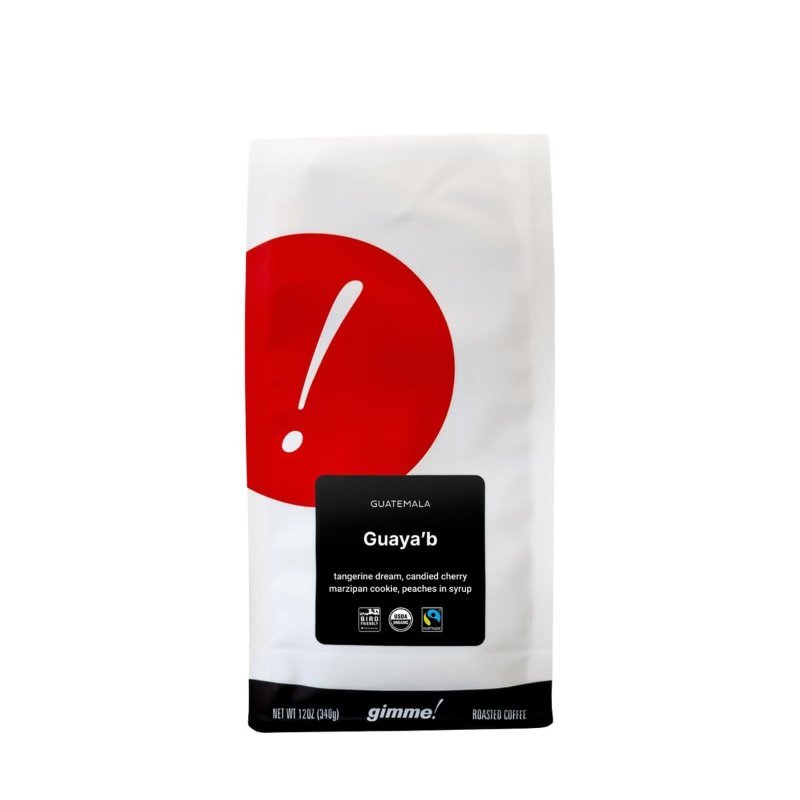
If you want to test the premise rather than the marketing, buy something that is actually certified rather than merely described. The Guatemala Guaya’b from Gimme! Coffee is the cleanest example I have found that is easy to get: Smithsonian Bird Friendly, organic, and Fairtrade, sourced from the Guaya’b association in Jacaltenango, Huehuetenango — a smallholder co-op of Popti’, Q’anjob’al and Mam growers founded in 1998, farming between roughly 1,400 and 1,650 meters. It arrives whole bean in 12 ounce bags, which matters, because a certification premium is wasted money if you are buying it pre-ground.
It is a medium roast, which is not where I would normally point a pour-over drinker, but it suits this coffee — Huehuetenango at that elevation gives you enough acidity that a medium roast lands as cocoa and orange rather than mud. Brew it a touch coarser than your usual and give it a full 45-second bloom.
Guatemala Guaya’b — Bird Friendly, Organic, Fairtrade (Gimme! Coffee, 12 oz whole bean)
An actual Smithsonian Bird Friendly lot from the Guaya’b co-op in Huehuetenango, roasted in Ithaca, NY. Medium roast, cocoa and citrus, and the rare bag where the sustainability claim is auditable rather than decorative.
The short version
Ignore the words “shade-grown” on a bag; they mean nothing on their own. Look for the Bird Friendly seal, which means something specific and verifiable. Expect the shade to give you a slightly sweeter, denser, better-roasting bean — with the caveat that shade travels with a lot of other good farming you can’t separate out. And adjust your expectations on the conservation side: you are funding habitat corridors around forests, not the forests themselves. That is a real thing to fund. It just isn’t the poster.