Ask an American coffee person to name a Korean coffee city and you will get Seoul, if you get anything. That is a dated answer. Busan — the port city on the southeast coast, second-largest in the country — has spent the last fifteen years building a specialty scene that is arguably more interesting than the capital’s, and it did it without the capital’s money or press.
The numbers behind this are not subtle. South Korea drinks roughly 405 cups of coffee per person per year, more than double the global average of about 152, and some estimates put it higher still. There are over 100,000 coffee shops in a country of 51.7 million people. That density does two things: it makes mediocre coffee unsurvivable, and it pushes the good operators toward specificity — a single roast profile, a particular sourcing relationship, one thing done obsessively.
Momos, and why Busan stopped apologizing for not being Seoul
The pivot point has a name and a date. In April 2019, Jooyeon Jeon of Momos Coffee won the World Barista Championship in Boston — the first Korean to take the title, and only the second woman ever to win it. She was not from Seoul. She was from a roastery in Busan that had started in 2007 as a takeout coffee bar carved out of a restaurant storage room, roughly 140 square feet of floor space.
Momos now runs a barista academy, a two-story bakery café, a nationwide distribution business, and — since December 2021 — a converted logistics warehouse in Bongrae-dong, Yeongdo, that houses green coffee storage, production, and a coffee bar under one roof. They have been travelling to origin since 2011 and buy from more than 150 partner farms across 20-plus countries. In February 2026, at Coffee Fest Madrid, Momos was named 22nd on the World’s 100 Best Coffee Shops list, one of only two Korean cafés to make it (Seoul’s Lurii Coffee landed at 51).
That matters beyond bragging rights. A world title won by a non-capital roaster gave every other Busan operator permission to take themselves seriously, and the scene filled in fast behind it.
What the rest of the city actually looks like
It is not a monoculture. Blackup Coffee, founded in 2006 by roaster Kim Myeong-sik, has grown to ten branches and more than 70 baristas — one of the largest specialty brands in the country, and proof that Busan can scale without going industrial. Hytte Roastery sits on a second floor above the rooftops and roasts its own. Naive Brewers in Jeonpo is a small room that reads more like someone’s living room than a café, with a single-group La Marzocco and a homemade wooden counter. Requirement Coffee Brewers imports most of its green from Australia, which is a genuinely strange and specific choice that tells you the owner has an argument to make.
The through-line is roast level. Busan cafés lean light — washed and honey-processed lots pulled short of any real caramelization, served as filter as often as espresso, with the fruit and floral character left intact rather than roasted flat. If you drink pour-over the way most of this site’s readers do, the Busan cup is already your cup. It is the profile you get when a roaster trusts the green enough to stay out of its way.
How to drink it from here
The obvious problem: Momos does not sell into the U.S. Amazon supply chain, and neither does Blackup or Hytte. You can order direct from Korea and pay for it in shipping and staleness, or you can find the closest thing roasted domestically. I would do the second.
Some links below are affiliate links — if you buy through one, this site earns a commission at no extra cost to you.
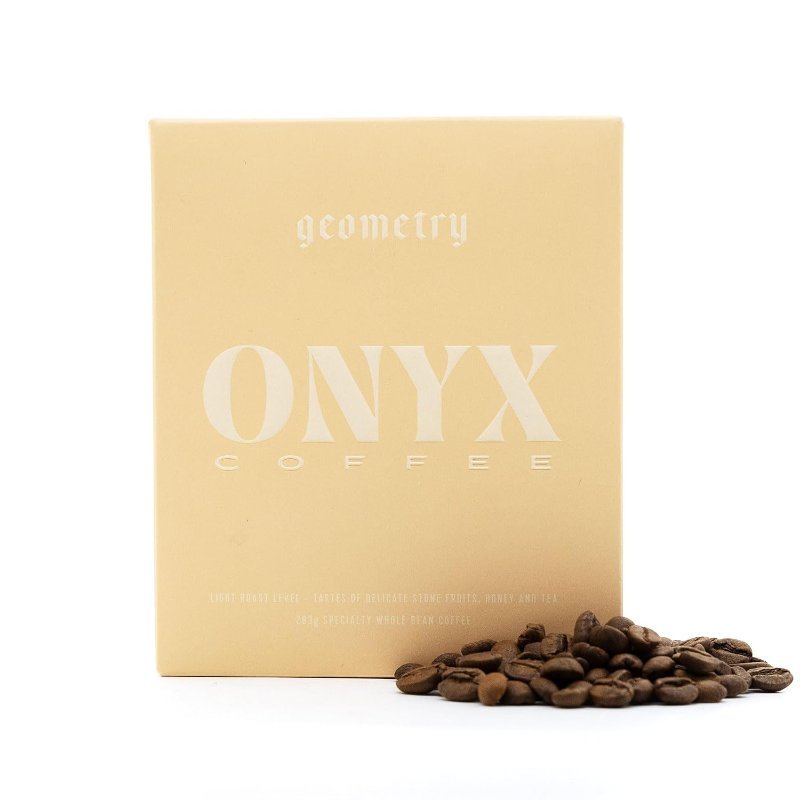
What you are looking for is a light-roasted, washed, direct-trade blend built on Ethiopian green with the fruit left in — and the closest thing on Amazon is Onyx Coffee Lab’s Geometry. It is a blend of washed Colombian and Ethiopian, roasted light, and Onyx serves it as the house filter coffee in their own cafés, which is the relevant detail: it is not an espresso-only bean despite the label. The stated notes are berries, sweet lemon, Earl Grey, and honeysuckle, and the Earl Grey descriptor is the tell — that bergamot-adjacent floral quality is exactly what a Busan roaster is chasing and exactly what a darker roast destroys. Onyx is also the closest American analogue to Momos in temperament: competition-driven, direct-trade, obsessive about a single profile.
The Closest You’ll Get Stateside
Onyx Coffee Lab Geometry — Light Roast Whole Bean
Washed Colombian and Ethiopian, roasted light and used as Onyx’s own house filter coffee. Berries, sweet lemon, Earl Grey, honeysuckle — the fruit-forward, under-roasted profile Busan cafés are built on.
Brew it hot and a little coarser than you think — light-roast blends like this one are dense and will run sour if you under-extract them, which is the single most common way people ruin a bag like this at home. A 1:16 ratio, water just off the boil, and a slow steady pour will get you most of the way to what they are pouring in Jeonpo.
Worth the trip?
If you are ever routed through Incheon with a spare day, Busan is a two-and-a-half hour KTX ride and a better coffee city than the reason most people go. Yeongdo alone — the island district where Momos put its roastery in an old warehouse — will fill an afternoon. Until then, buy light, brew carefully, and stop assuming Seoul is the whole story.