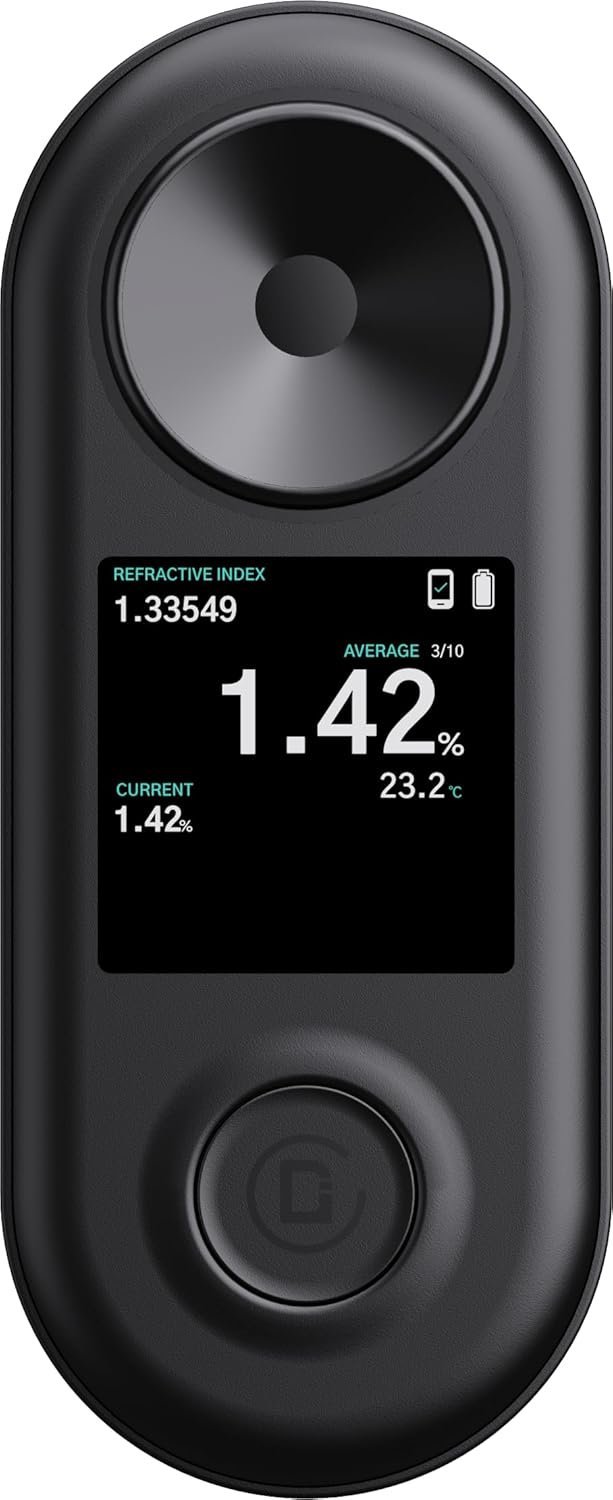
A refractometer is the piece of coffee gear most likely to make a houseguest ask what is wrong with you. It is a small sealed box with a sample well, it costs more than most grinders people own, and its only job is to tell you a number between roughly 1.15 and 1.45. That is it. No brewing, no grinding, no heating. Just a number.
I have been living with one for a few months, and my position is more complicated than either camp wants it to be. It is absolutely overkill for most home brewers. It is also the single most useful diagnostic I own, and I would not give it back.
What the number actually is
A refractometer measures total dissolved solids — TDS — by shining light through a drop of your brewed coffee and reading how much that light bends. Denser liquid bends light more. The device converts that bend into a percentage: what share of what is in your cup is coffee rather than water. Filter coffee typically lands somewhere between 1.15% and 1.45%.
That number alone is strength, not quality. The useful part comes when you combine it with the two numbers you already have — dose in, beverage out. Multiply your brew weight by your TDS percentage, divide by your dose, and you get extraction yield: the percentage of the coffee grounds that actually dissolved into the cup. The Specialty Coffee Association’s brewing control chart puts the pleasant zone at roughly 18% to 22% extraction. Below that you get sour, thin, grassy coffee because you have pulled the acids but left the sugars behind. Above it you start washing out the dry, astringent compounds nobody wants.
Where it earns its keep
The reason a refractometer is worth anything is that it separates two problems that taste almost identical to an untrained palate. Weak coffee and underextracted coffee are not the same thing, and the fix for one makes the other worse. A cup that reads 1.10% TDS at 21% extraction is simply too dilute — use less water. A cup that reads 1.30% TDS at 16% extraction is strong and underextracted — grind finer, pour slower, do not touch the ratio. Without a number I would have chased those two failures in the same direction and gotten nowhere.
The other real use is settling arguments with yourself. I was convinced for a long time that a particular pouring pattern was pulling more out of the bed. Measured across six brews, the difference was inside the instrument’s own margin of error. That is a slightly deflating result, but it saved me from building a ritual around nothing. A refractometer is very good at telling you which of your habits are doing work and which are superstition.
Where it is genuinely useless
It will not tell you whether your coffee tastes good. Extraction yield correlates with pleasantness; it does not define it. A washed Ethiopian at 19% and a dark Sumatra at 19% are wildly different drinking experiences, and the device reports the same figure for both. Roast level, bean freshness, and water chemistry all move flavor around without moving the number much at all.
It also cannot fix a bad grinder. If your burrs are producing a wide particle spread, you will get inconsistent readings that reflect a real physical problem you cannot solve with data. Buying a refractometer before buying a decent grinder is spending $230 to be told, precisely, that you should have spent it on a grinder.
And there is a sampling problem people gloss over: you have to cool and stir the sample properly, or the reading drifts. A hot, unmixed drop reads differently from the same coffee at room temperature. That is a discipline requirement, not a device flaw, but it means casual use produces casual data.
The one worth buying
Some links below are affiliate links — if you buy through them, this site earns a commission at no extra cost to you.
The market splits cleanly. Lab-grade units from VST run around $700 and exist because commercial roasteries and competition judges need defensible readings. Cheap $30 refractometers from unbranded sellers advertise ±0.2% accuracy, which is ten times coarser than the differences you are trying to detect — at that resolution the tool is decorative. The interesting product is the one in the middle, and right now that is the DiFluid R2 Extract.
The Pick
DiFluid R2 Extract Coffee TDS Refractometer
0–30% TDS range at ±0.02% precision with 0.01% resolution — fine enough that a 1.35% versus 1.45% reading is real signal, not noise. CMOS sensor recalibrates before every measurement, the aluminum sample dish equalizes temperature in about four seconds, and it is IP67 waterproof and USB-C rechargeable. Pairs to a phone app that logs readings and does the extraction math for you.
At a bit over $200 it sits at roughly a third of the VST price while matching it closely enough in independent comparisons that the gap stops mattering for home use. The app logging is the part I underrated going in — having a searchable history of every brew, with the yield already calculated, is what turns the device from a gadget into an actual feedback loop.
So: overkill, or interesting?
Both, and the order matters. If you are still figuring out grind size, still using pre-ground coffee, or still brewing by eye rather than by scale, a refractometer will hand you numbers you have no framework to act on. Buy a scale, buy a burr grinder, buy fresher beans — in that order — and you will improve far more per dollar.
But if you already weigh everything, already brew the same recipe daily, and have hit the wall where your coffee is fine but you cannot articulate why it is not better, this is the tool that turns vague dissatisfaction into a specific, fixable variable. That is a narrow use case. It is also exactly the person who reads a website about pour-over.