Geisha is the coffee that ruined price expectations for everyone. A single washed lot from Hacienda La Esmeralda sold at the 2025 Best of Panama auction for $30,204 per kilogram — roughly $13,700 a pound — to a buyer in Dubai. That is not a coffee. That is a collectible. And it sits at the top of a pyramid whose bottom rung is the $40 half-bag you can actually put in a grinder.
So the question worth answering is not whether the auction lots are worth it. Nobody reading this is bidding. The question is whether the accessible end of the Geisha market — the $35 to $60 bags on Amazon — delivers something you cannot get from a $22 Ethiopian. I brewed one to find out.
Where Geisha actually comes from, and why it costs this much
The variety is Ethiopian. It was collected in the 1930s from the Gori Gesha forest in the Bench Maji zone, moved through Tanzania, reached Costa Rica in the 1950s, and was distributed around Panama by the 1960s — largely as a rust-resistant curiosity, not as a flavor play. For forty years it sat in Panamanian fields being ignored.
Then in 2004 the Peterson family at Hacienda La Esmeralda noticed that during a wet, disease-heavy season one block of trees was staying conspicuously healthy. They isolated the lot, cupped it separately, and entered it in Best of Panama. Judges reported something closer to jasmine tea than to coffee. It won and sold for $21 a pound — about ten times the going rate for excellent coffee at the time. The variety went from footnote to obsession in a single auction.
The price never came back down, and there is a real agronomic reason for that beyond hype. Geisha trees are tall, leggy, and unproductive — yields run roughly 20 to 30 percent below conventional arabica varieties. They also need serious elevation to express the floral aromatics people are paying for; grow Geisha low and you get a thin, unremarkable cup and a farmer who lost money. Low yield plus a narrow window of suitable land plus enormous demand is the entire pricing story. It is not a marketing invention.
The bag I brewed
Here is the disclosure: the link below is an Amazon affiliate link, and I earn a commission if you buy through it. It does not change what I think of the coffee.
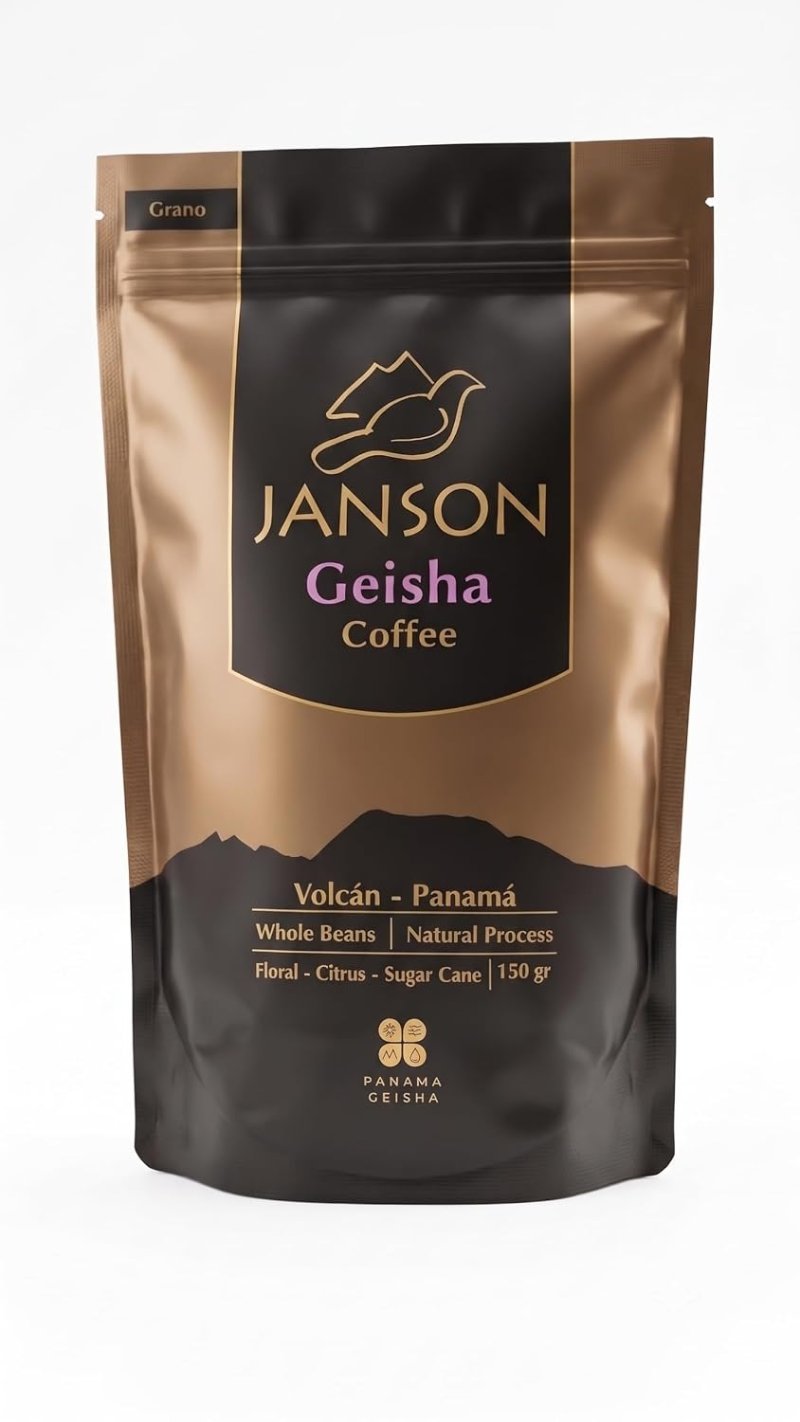
I went with Janson, and specifically because it is a farm with a paper trail rather than an anonymous “Panama Geisha” bag from a reseller. The Janson estate was founded in 1941 by Carl Axel Janson as a cattle operation in Volcán, Chiriquí; his sons turned it into a coffee farm in 1989. It sits between the Barú and Tisingal volcanoes at roughly 1,350 to 1,700 meters, and it has real Best of Panama placements — second for washed Geisha in 2013, third for natural Geisha in 2016. That is a farm competing near the top without charging Esmeralda money.
An October update before you click anything: the natural-process bag I brewed is no longer orderable on Amazon — the listing has gone to “currently unavailable” with no restock date, which is what happens to a 200-gram lot from a single estate once it runs out. Everything below is still a review of that bag, because that is the coffee I drank. What Janson still has on Amazon is the washed version, same farm and same price, and by the post’s own logic further down it is arguably the more instructive bottle to start with: washed Geisha is where the famous tea-clarity descriptions come from. Expect more jasmine and less jam than what I describe below.
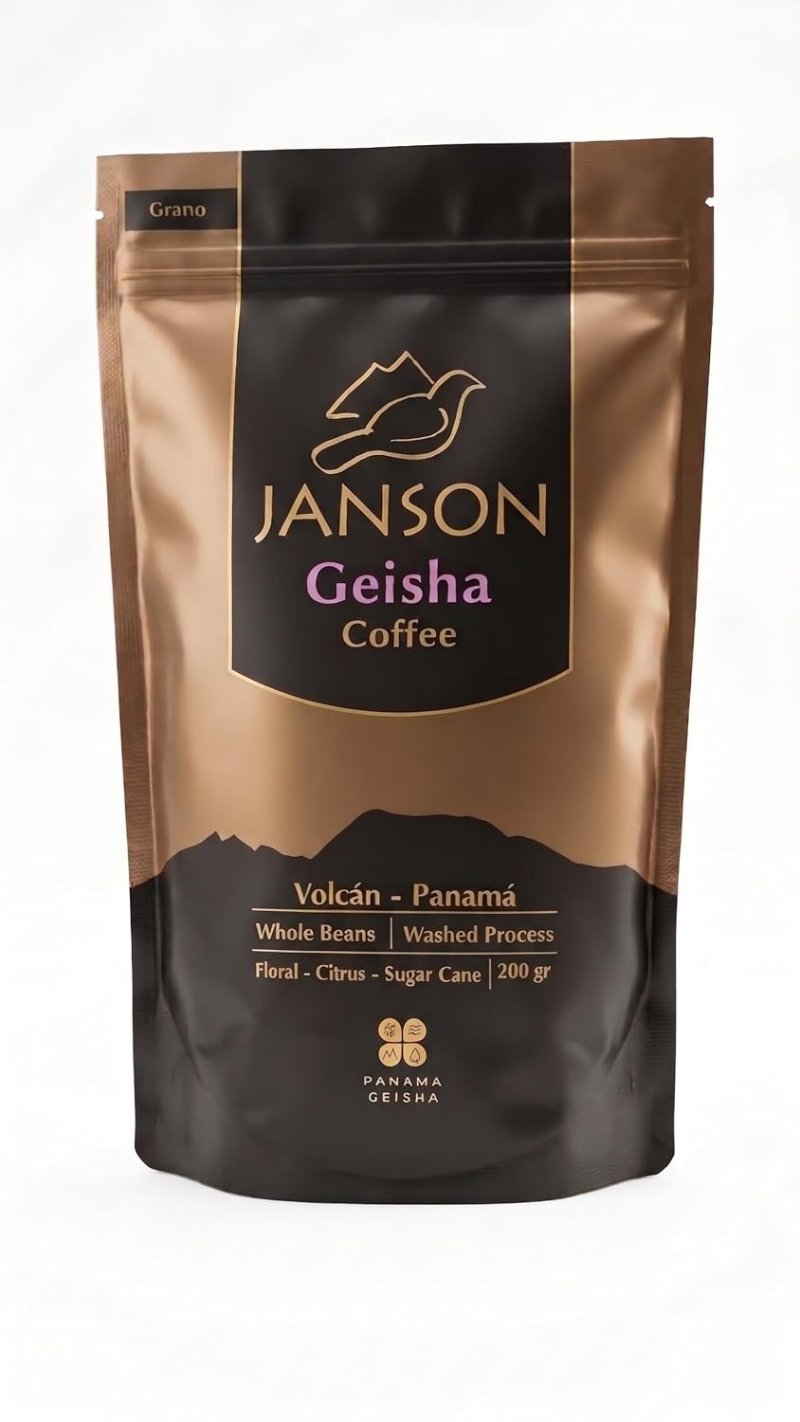
Janson Family Coffee Panama Geisha — Washed, Whole Bean, 200g
Same Chiriquí highlands estate, same Best of Panama pedigree, same $40 — the washed lot instead of the natural, because the natural has sold out. Washed is the clearer, more floral side of the variety, and 200 grams is the right amount of Geisha to buy.
One caveat on the listing itself, because it annoyed me on the natural bag and it has carried over to the washed one: the title says Boquete while the bullets put the farm between 1,600 and 1,700 meters, and the farm is actually in Volcán, about forty minutes west of Boquete. Both are Chiriquí highlands and the coffee is the coffee, but sloppy listing copy on a $40 bag is not a great look. Check the weight you are being sent before you assume you are getting a quarter kilo.
What it tastes like
This is a natural process Geisha, which means the fruit dried on the bean and the cup leans further toward jam than tea. At a 1:16 ratio in a V60, ground noticeably coarser than I would use for a Kenyan, it came out with bergamot and stone fruit up front, a jasmine note that shows up mostly in the aroma of the wet bed rather than in the cup, and a finish that is more like a good oolong than like coffee. The body is light. If you like a heavy, syrupy cup, you will read that as thin and you will be irritated that you paid $40 for it.
The washed versions of Geisha are the ones that produce the famous tea-clarity descriptions. The naturals trade some of that transparency for sweetness and fruit intensity, which makes a natural the friendlier first encounter — the flavors announce themselves instead of asking you to concentrate. That is the bag I had, and it is the bag that has sold out. The washed Janson lot linked above is the harder, more rewarding version of the same exercise: brew it with attention and it will show you the jasmine that made this variety famous.
Brew it carefully or do not bother
Geisha is unforgiving in a specific way: it is delicate, so every brewing sin shows up immediately. Grind too fine and the fragile aromatics get buried under bitterness. Use water that is too hot and you flatten the florals. My settings, which are a starting point and not gospel: 205°F, a coarser grind than your normal pour-over setting, 1:16, gentle pours, no aggressive agitation. And use decent water — the mineral content matters more here than it does with a forgiving Brazilian.
Do not buy Geisha pre-ground, and do not buy a pound of it. The volatile aromatics that justify the price are the first thing to go. A 150 to 250 gram bag is the correct purchase size; you should finish it inside three weeks.
Is it worth it?
Once, definitely. Geisha is one of the few coffees where the flavor difference is not subtle enough to argue about — it tastes like a different agricultural product, and everyone should experience that at least one time so they know what the ceiling of the variety actually is.
As a habit, no. At $40 for a small bag you are paying roughly five times what an outstanding Ethiopian Yirgacheffe costs, and you are not getting five times the cup. A well-sourced washed Ethiopian at $20 gets you eighty percent of the floral experience for a fifth of the money. Buy the Geisha as a calibration exercise, enjoy it properly over a couple of weeks, then go back to drinking coffee you can afford to make badly on a Tuesday morning.