A coffee scoop is the least interesting object in a kitchen. It costs a few dollars, it does exactly one thing, and the only real problem with it is that you can never find it. Mine used to live in a drawer about two feet from the grinder, which in practice meant it lived in the drawer and I dosed by eye.
At some point a manufacturer glued a magnet into the handle of one, and that is the whole product. No new function, no better accuracy — just a scoop that sticks to things. It is a dumb idea in the best sense, and after a few months of using one I am not going back.
What the magnet actually fixes
Visible tools get used. A scoop stuck to the side of a steel canister sits in your eyeline every morning, so you reach for it instead of estimating. A scoop in a drawer gets skipped, and skipping it is how you end up with a mug that tastes different every day for no reason you can name.
The second thing it fixes is less obvious: it keeps the scoop out of the bag. Burying a scoop in your beans means fishing it out with your fingers every morning, and a scoop that lives in the coffee is a scoop that has also lived in the sink, the dish rack, and the counter. Parking it on the outside of the container keeps the handle and the bowl out of the beans entirely.
The catch nobody puts on the box
Here is the part that trips people up: a lot of the kitchens these are sold into have nothing magnetic in them. “Stainless steel” is a family of alloys, not one material, and only some branches of that family are magnetic. The British Stainless Steel Association describes the ferritic grades as “a soft ferro-magnetic group” with a body-centred-cubic crystal structure — the same structure as pure iron at room temperature. That is why a magnet will leap onto one steel canister and slide straight off the next one, with both of them legitimately labelled stainless.
Fridge doors are the same story. Plenty of stainless-fronted refrigerators will not hold a magnet at all, which surprises people who assumed the fridge was the backup plan.
And if you store beans in glass — which has real advantages, as the glass canister roundup gets into — there is simply nothing there to grab. A magnetic scoop next to a glass jar is just a scoop with a lump in the handle. Before you buy one, hold a fridge magnet against whatever you actually keep coffee in. Thirty seconds, and it settles the question.
It is still a scoop, so it is still wrong about weight
The National Coffee Association puts its “Golden Ratio” at one to two tablespoons of ground coffee for every six ounces of water. That is a volume rule, and volume rules are approximations by nature. Roast level changes how dense a bean is, so a level scoop of a dark roast carries fewer grams than the same scoop of a light roast. Grind fineness changes how the grounds pack into the bowl on top of that.
So be clear about what you are buying. The magnet solves a storage problem, not a measurement problem. If you care about hitting the same ratio twice — and that ratio is where most day-to-day consistency comes from, as the piece on estimating extraction without a refractometer lays out — the scale comes first and the scoop is just the shovel that gets beans from the bag to the grinder. That ordering is the same one in the starter shelf list, and it has not changed.
The three I would actually buy
All three are real purchases I would stand behind at their price, which is to say somewhere between three and fifteen dollars. The links below are affiliate links, so the site earns a commission if you buy through one, at no extra cost to you.
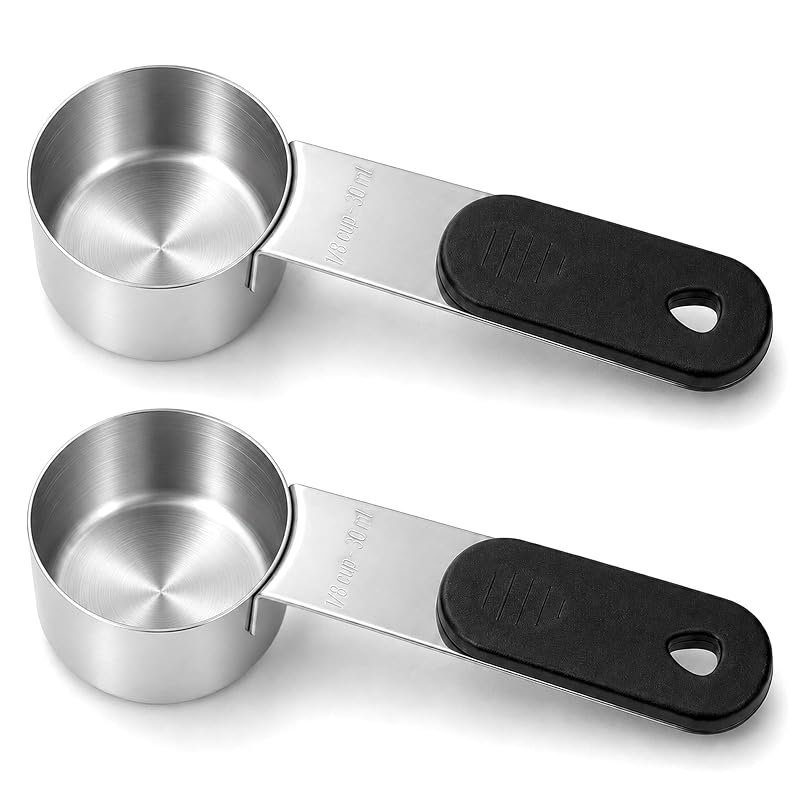
Start with the literal version of the thing: a pair of stainless 1/8-cup scoops with magnets in them. An eighth of a cup is two tablespoons, which puts a single level scoop at the top of the NCA range for a six-ounce cup and roughly in the right neighbourhood for a small pour-over. Two in the pack means one can live on the canister and one in the travel kit, and at this price losing one is not an event.
Magnetic 1/8-Cup Coffee Scoops (2-Pack)
Two stainless 1/8-cup (2 tbsp) scoops with magnets in the handles. Deep bowl, short handle, sticks hard to a ferrous canister. There is nothing clever here beyond the magnet, which is the point.
If you would rather the magnet came attached to something more useful, the stackable measuring spoon sets are the better value. You get a run of sizes instead of one, they nest into a single magnetic brick so the drawer stays sane, and the tablespoon end does coffee duty while the smaller ones handle the spice and syrup work that comes up constantly in latte recipes. The honest downside: the quarter-teaspoon sizes are useless for coffee and you will never touch them.
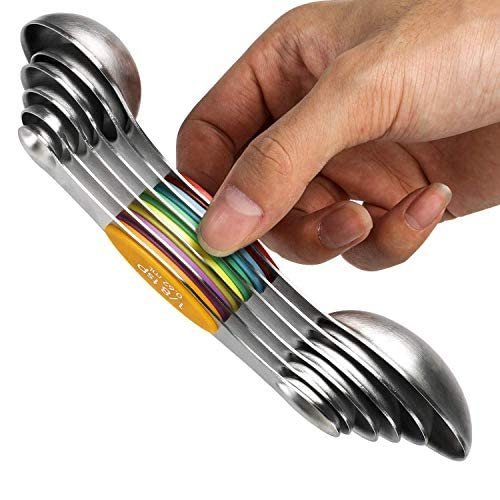
Magnetic Measuring Spoons Set (Dual-Sided, Stackable)
Dual-sided stainless spoons that stack and hold together magnetically. The tablespoon end is your coffee scoop; the rest earns its keep elsewhere in the kitchen. Fits in spice jars, which the fat coffee scoops do not.
And if the magnet test came back negative — glass jars, a non-magnetic fridge, beans still in the bag they came in — skip the magnet entirely and buy the clip instead. A bag-clip scoop seals the bag shut and then stores on it, which solves the same “where did the scoop go” problem using a mechanism that works on every container in existence. Norpro has made this one for years at a 1.5-tablespoon bowl.
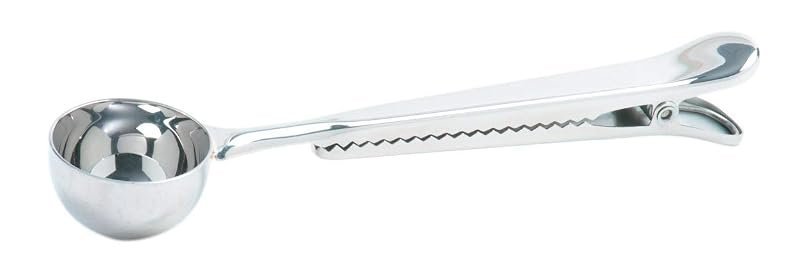
Norpro Coffee Scoop with Bag Clip
A 1.5 tbsp stainless scoop with a sprung clip built into the handle. Clips the bag closed, lives on the bag, needs no steel anywhere. The least glamorous answer and the most universal one.
Who should skip this
If you already dose by weight every morning, a magnetic scoop changes nothing about your coffee — it is a shovel that happens to park itself, and any shovel will do. If you store beans in glass, the magnet is dead weight. And if your grinder has a hopper you fill once a week, the scoop barely comes out at all.
Everyone else: a few dollars to stop losing a tool you use every single day is one of the better small trades in a kitchen. It also makes a respectable stocking-filler, which is why something in this category keeps turning up in the gifts under $25 list. Low stakes, low price, and the kind of fix you stop noticing because it quietly stopped being a problem.