The coffee-and-climate story usually gets told as a prophecy: some year in the 2050s, coffee disappears, enjoy it while you can. That framing is both alarmist and weirdly comforting, because it puts the problem safely in the future. The more useful version is less dramatic and more annoying — the change already happened, it is in the bag on your counter right now, and it explains a lot of things pour-over drinkers have been grumbling about for two years.
The heat arrived before the deadline
In February 2026, Climate Central published an analysis of daily temperatures from 2021 through 2025 across 25 countries that together grow about 97% of the world’s coffee. The metric they used is simple: days above 30°C (86°F), which is roughly where arabica stops being happy and starts being stressed. Averaged across those countries, human-caused warming added about 47 extra days per year above that threshold. Among the top five producing countries — the ones responsible for roughly three-quarters of global supply — it was closer to 57 extra days. El Salvador picked up 99. Nicaragua, 77. Thailand, 75.
Think about what that means at farm level. That is not a bad week. That is an extra month and a half, every year, of conditions the plant did not evolve for, on top of whatever the season already threw at it.
Heat does specific things to flavor, not vague ones
The reason altitude has always been shorthand for quality is that cool air makes the cherry ripen slowly. Slow ripening means a longer fruit-fill period, which means more time to accumulate the sugars, acids, and aromatic precursors that turn into flavor during roasting. That is the entire mechanism behind why a 2,000-meter Ethiopian tastes like tangerine and a hot-lowland commodity lot tastes like brown.
Push the temperature up and you compress that window. The cherry ripens faster, the plant banks fewer flavor precursors, and the resulting cup tends to skew flatter and more bitter — the acids, lipids, and sugars shift measurably, not just impressionistically. Heat-stressed plants are also more vulnerable to pests and disease, which is its own separate problem. So the practical result is not “coffee is gone.” It is “the same farm, same varietal, same processing, quietly scores lower than it did a decade ago.”
The map is being redrawn, and not evenly
Rabobank, which lends to a great deal of global agriculture and therefore has strong incentive not to be theatrical about this, published a 2026 assessment of arabica land suitability. Their read: about 8% of current arabica-growing area is already in conditions best described as unsuitable — higher input cost, lower output — and roughly 20% of today’s cultivation area could be unsuitable by 2050.
The country-level numbers are where it gets interesting. In Brazil, the share of the harvest coming from genuinely suitable land is projected to fall from 81% to 62%; suitable Brazilian land currently yields about 32.6 bags per hectare versus about 28 in unsuitable zones, so that shift is a real production hit, not a rounding error. Colombia goes from 56% to 45%. Honduras falls off a cliff, from 53% to 12%.
And then there is Ethiopia, which is projected to gain — its suitable zones expand, and its highly suitable area may triple. Coffee’s origin point ends up as one of the few places the math improves. That is not a happy ending so much as a reshuffling, but it does have a direct consequence for what you buy.
Why your bag price keeps lurching around
Climate does not show up in the price as a smooth upward line. It shows up as volatility, because a warmer atmosphere makes the extremes wider in both directions. Right now is a good illustration: Brazil’s 2026/27 harvest is forecast at a record 71.9 million bags combined, with arabica rebounding by 9.5 million bags to 47.5 million after five straight underperforming years, largely because rains landed on schedule during September and October flowering in Minas Gerais. Meanwhile Vietnam’s Central Highlands has been running dry, with scattered showers insufficient for good cherry development, and robusta futures moved on it.
One record crop and one worrying one, in the same season. That is the pattern to expect — not a steady climb, but a whipsaw, where any single origin can be excellent or expensive depending on a few weeks of weather.
What to do about it as a person who just wants good coffee
Two things, neither heroic. First, stop treating a favorite origin as permanent. If you have been buying the same Colombian for six years and it tastes duller than it used to, that is plausibly the coffee, not your palate. Second, buy from the regions the climate math currently favors, and buy organic/shade-grown where you can — tree cover is one of the few adaptation levers smallholders actually have, since shade buffers the canopy temperature that Climate Central is measuring.
Heads up: the link below is an affiliate link, so we earn a commission if you buy through it, at no extra cost to you.
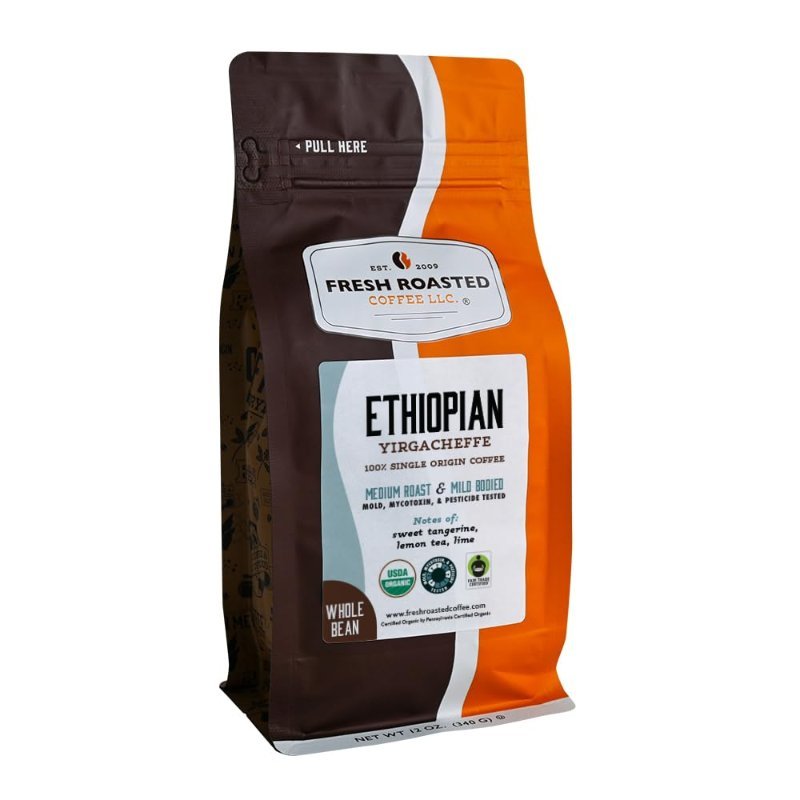
Which is a long way of arriving at Ethiopian Yirgacheffe. It is the obvious pick here and for once the obvious pick is also the defensible one — it is the region the suitability models say is expanding rather than contracting, and it happens to be the clearest possible demonstration of what slow, high-altitude ripening does to a cup. The Fresh Roasted Coffee organic Yirgacheffe is the version I keep buying: light roast, whole bean, Fair Trade and USDA Organic, and it tastes like the citrus-and-lemon-tea profile the region is famous for rather than a roasty approximation of it. It is inexpensive enough to drink as a daily bag, which matters more than owning one heroic $40 microlot.
Fresh Roasted Coffee — Organic Ethiopian Yirgacheffe, Light Roast (12 oz)
Fair Trade and USDA Organic whole bean from the region climate models say is gaining ground. Bright tangerine and lime, a clean lemon-tea finish, and a light roast that actually lets the origin through.
None of this is a reason to panic-buy coffee. It is a reason to pay a little more attention to where the bag came from, and to accept that the sourcing landscape you learned five years ago is already out of date.