Take a sip of a well-brewed Kenyan pour-over and the first thing you notice is that it bites back. Blackcurrant, grapefruit, sometimes an almost savory tomato-like tang — a brightness that no other origin quite reproduces. People toss around the word “acidity” like it’s one thing, but Kenya’s version is specific and recognizable, and it exists because of three deliberate choices: what got planted, where it got planted, and how it gets processed. None of it is an accident.
It starts with two varietals from the 1930s
Nearly everything remarkable about Kenyan coffee traces back to SL28 and SL34 — selections made in the 1930s by Scott Agricultural Laboratories, the “SL” in the name. The lab was actually screening for drought tolerance, not flavor. SL28 came from drought-resistant stock with roots in Tanzania and Sudan; the stunning cup quality was a side effect nobody ordered. Grown at altitude, SL28 in particular throws that intense blackcurrant note and a sharp, sparkling acidity that reads almost like biting into fruit. SL34 is a bit heavier and more forgiving, and the two get interplanted and blended constantly. When a bag says Kenya and tastes like Kenya, you are almost certainly drinking one or both.
The soil is doing real work
Kenya’s classic growing regions — Nyeri, Kirinyaga, Murang’a, Kiambu — sit on the slopes of Mount Kenya and the Aberdare Range, in deep red volcanic soil that’s unusually rich in phosphorus. Coffee people describe the resulting sensation as phosphoric acidity: a clean, cola-like sparkle rather than the softer malic (apple) or citric notes you get elsewhere. Whether the phosphorus in the dirt translates directly into phosphoric acid in the cup is a live debate among coffee chemists, but the correlation is hard to ignore, and side by side against a Colombian or a Brazilian, the difference is not subtle.
Altitude slows everything down, and that’s the point
Most Kenyan coffee grows between roughly 1,400 and 2,000 meters. Cool nights at that elevation slow cherry maturation, and slower maturation means denser beans with more concentrated sugars and organic acids. It’s the same reason high-grown Central American coffees outperform their lowland neighbors — Kenya just pushes the formula harder, with equatorial sun, serious elevation, and those volcanic soils stacked on top of each other.
The double wash nobody else bothers with
Processing is the last piece. The traditional Kenyan method is a washed process with an extra step: after the first fermentation and washing, the beans go through a second fermentation and then an extended soak in clean water, often overnight. That double fermentation strips every trace of fruit pulp and produces the transparency Kenya is famous for — the cup tastes vivid and clean, with the acidity front and center instead of buried under fermenty mush. It’s more work and more water, which is exactly why most origins skip it.
One thing AA does not mean
Quick detour, because this trips people up: AA is a screen size, not a quality score. Kenyan lots are graded by bean size — AA is the largest standard grade, AB below it, PB for peaberries. Big beans correlate loosely with quality and command a premium at Nairobi’s coffee auction, but a great AB from a top factory will beat a mediocre AA every time. Treat AA as a clue, not a verdict. (For more on peaberries specifically, we reviewed a Kenyan peaberry from Volcanica just yesterday.)
Taste it for yourself
We may earn a commission if you buy through the links below, at no extra cost to you.
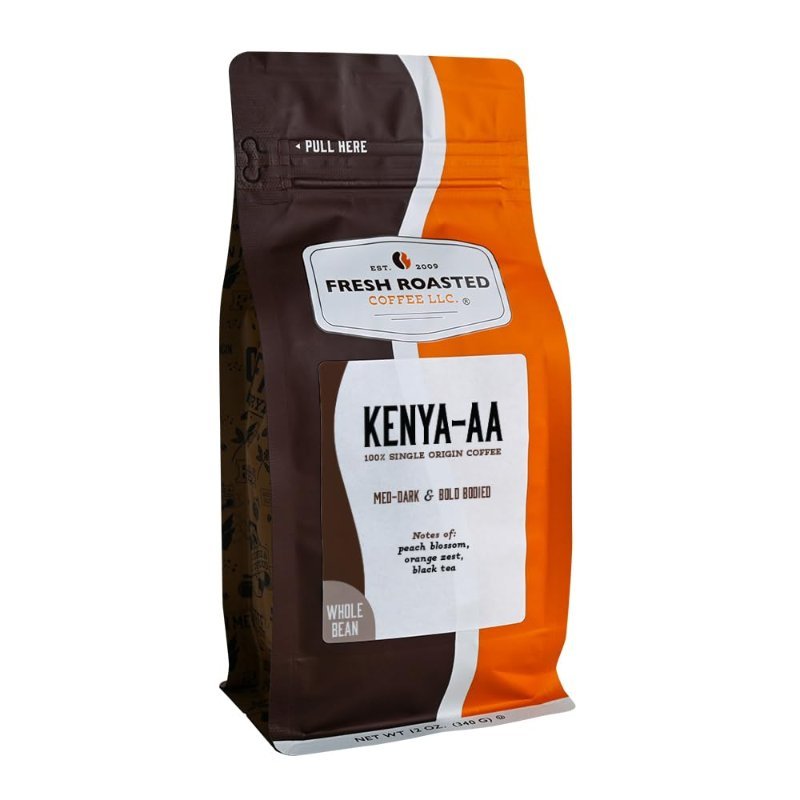
The most painless way to try a proper Kenya AA without hunting down a specialty roaster’s drop schedule is Fresh Roasted Coffee’s Kenya AA. It’s roasted a touch darker than we’d choose — medium-dark takes some edge off that signature brightness — but the blackcurrant character and winey depth still come through clearly on a pour-over, and it’s consistently in stock and fairly priced. If you brew it, go a little finer than usual and keep the water just off boil; Kenya rewards a slightly pushed extraction. And if this bag makes you a convert, your next move is a light-roast single-farm lot from Nyeri or Kirinyaga — that’s where the acidity turns from bright to electric.
Fresh Roasted Coffee Kenya AA, 12 oz Whole Bean
A real Kenya AA that’s actually easy to buy. Blackcurrant and winey fruit survive the medium-dark roast; brew it as pour-over to see what the fuss is about.