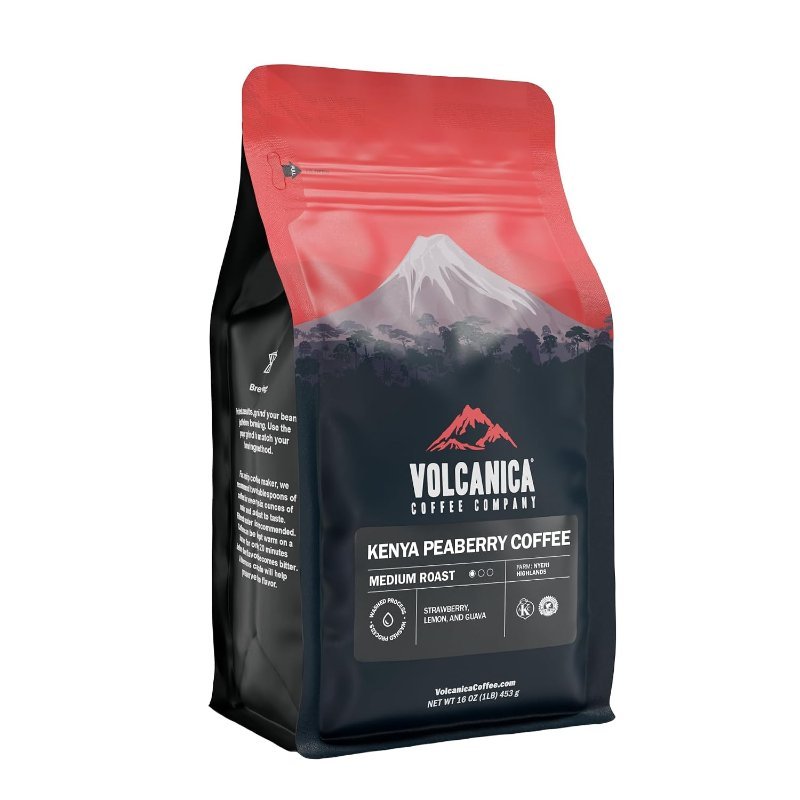
Kenyan coffee is the one origin I never talk anyone out of. It’s loud in the best way — blackcurrant, tomato-vine acidity, a sweetness that reads almost like Ribena if you grew up on it. So when a bag says “Kenya Peaberry,” I pay attention, because peaberry is Kenya’s already-intense character turned up another notch. I brewed through a bag of Volcanica’s Kenya Peaberry to see whether the label lives up to the reputation, and where it lands against a standard Kenya AA.
What “peaberry” actually means
A normal coffee cherry grows two flat-faced seeds pressed against each other. Roughly 5–10% of the time, only one seed develops, and instead of being flattened it grows round — a little pea. That’s a peaberry. It isn’t a variety or a region; it’s a natural quirk that gets sorted out of every harvest and sold as its own lot.
The claim behind the premium is that a single seed hoards all the nutrients the cherry meant for two, so the flavor concentrates. I’m mildly skeptical of the “double the flavor” marketing — the bigger, provable advantage is physical. A round bean tumbles and roasts more evenly than a flat one, and even roasting is a real quality lever, especially on a coffee this acidity-forward where a scorched edge would turn bright into sour. So peaberry lots tend to taste cleaner and more consistent, which is worth something on its own.
Why Kenya specifically
Kenya earns its reputation the hard way. Most of the good stuff comes from the volcanic highlands around Mount Kenya and the Aberdare Range, grown between roughly 1,500 and 2,100 meters. The country runs a rigorous grading system — AA and AB refer to bean size, not cup quality, and peaberry (PB) is graded separately. The washed processing Kenya is known for, plus the SL-28 and SL-34 varietals bred locally in the 1930s, are a big part of why the cup comes out so bright and blackcurrant-heavy. This is not a mellow, nutty, disappear-into-your-oat-milk coffee.
The bag: Volcanica Kenya Peaberry
Full disclosure: the link below is an affiliate link, so if you buy through it I may earn a small commission at no extra cost to you. With that out of the way — this is the bag I’d actually point a curious drinker to. Volcanica is an Atlanta roaster that leans single-origin, and their Kenya Peaberry comes as a 16-ounce whole-bean, roasted on the lighter side of medium, which is exactly where you want a Kenya to sit so the acidity survives. Brewed as pour-over at a slightly coarser grind than I’d use for a Latin American coffee, it gave me clean blackcurrant up front, a tart cranberry-ish middle, and enough body to not feel thin. It is emphatically not a dark, chocolatey cup, and if that’s what your household likes, this will read as “too sour” — go in knowing that. Buy whole bean and grind it fresh; a coffee that trades this hard on brightness goes flat fastest when it’s pre-ground.
A lighter-medium roast that keeps Kenya’s signature blackcurrant brightness intact, with the even-roasting edge peaberry lots are known for. Best as fresh-ground pour-over.
Who should buy it
If you already know you like Kenyan coffee, or you like fruit-forward Ethiopian naturals and want to try the washed, tarter side of African coffee, this is an easy yes. If you drink your coffee black and think “bright” is a flaw rather than a feature, skip it — no bag of Kenya is going to convert you, and this one leans hard into exactly the thing you don’t like. For everyone in between, it’s a genuinely good introduction to why people get weird about Kenyan coffee in the first place.