Melbourne is the only city I can think of where a global coffee chain got beaten so badly it had to retreat. Starbucks opened in Australia in 2000, expanded fast, and by July 2008 announced it was closing 61 of its 84 stores — having accumulated roughly $105 million in losses over its first seven years. The usual explanation is that Australians have discerning palates. The real explanation is more specific, and it starts with a migration wave.
Where Melbourne’s coffee actually came from
After the Second World War, Australia took in enormous numbers of southern European migrants, and Victoria took a disproportionate share. Italian-born residents of the state went from 8,305 in 1947 to 91,075 by 1961 — an eleven-fold increase in fourteen years. They brought the espresso machine with them, and more importantly they brought the assumption that a coffee is something you stand at a bar and drink properly, not something you carry away in a cup.
The epicentre was Carlton, specifically Lygon Street, where Italian cafés became genuine social infrastructure. In the CBD, the landmark is Pellegrini’s Espresso Bar on Bourke Street, opened in 1954 by brothers Leo and Vildo Pellegrini, who had come out of the kitchen at Florentino’s up the road. Pellegrini’s is often credited with Melbourne’s first real Italian espresso machine; the honest version is that several Lygon Street cafés got theirs around the same time, and Pellegrini’s was probably first in the city centre. Either way, by the mid-1950s Melbourne had espresso bars staffed by people who had grown up with espresso.
That’s the head start. Melbourne didn’t discover good coffee in the third-wave era — it had a functioning café culture roughly fifty years before Starbucks arrived to explain coffee to it.
The flat white, and why the format matters
The flat white is Australia’s most successful culinary export of this century, and the drink in its recognisably Melbourne form settled into place around 1990. It matters less as a recipe than as a statement of priorities: a modest volume of milk, textured rather than foamed, in a cup small enough that the espresso still has a say. It is a drink designed around tasting the coffee.
Compare that to the twenty-ounce sweetened format Starbucks built its business on and the 2008 retreat stops looking mysterious. Melbourne wasn’t rejecting convenience. It already had a drink it liked, served by people it trusted, at a price lower than the newcomer was charging.
The modern roasting scene
Melbourne’s specialty wave came out of that café density rather than replacing it. St Ali was founded in 2005 by Salvatore Malatesta and became the training ground a startling number of Australian coffee people passed through. Seven Seeds followed in 2007, started by Mark Dundon and Bridget Amor, named for the seven coffee seeds the Sufi Baba Budan is said to have smuggled out of Yemen in the seventeenth century; they treat coffee as a seasonal product, with the lineup turning over through the year. Market Lane arrived in 2009, founded by Fleur Studd and Jason Scheltus, roasting small batches at Prahran Market and likewise sticking to seasonal offerings. Industry Beans, from brothers Trevor and Steve Simmons, rounded out the Fitzroy end of things.
The through-line is seasonality and restraint — light-to-medium roasting that leaves origin character intact, on the assumption that the customer will notice. That is a very different design brief from roasting for a drive-through.
How to drink Melbourne coffee from the United States
Here’s the practical problem: almost none of those roasters ship to the US in a way that makes sense. Airfreight on a $20 bag of coffee is absurd, and by the time it clears customs you’re outside the window where the coffee tastes like anything.
Fortunately there’s a shortcut, and it happens to live in our own city.
Some links below are affiliate links. If you buy through them we may earn a commission at no extra cost to you.
Proud Mary was founded in Melbourne in 2009 by Nolan and Shari Hirte, and has been roasting in Portland since 2017. It is not a Melbourne-inspired brand — it is a Melbourne roaster that opened a second home here, which means the roasting philosophy came over intact rather than being reverse-engineered from a magazine article. If you want to taste what Melbourne does to coffee without paying for international shipping, this is the closest thing available.
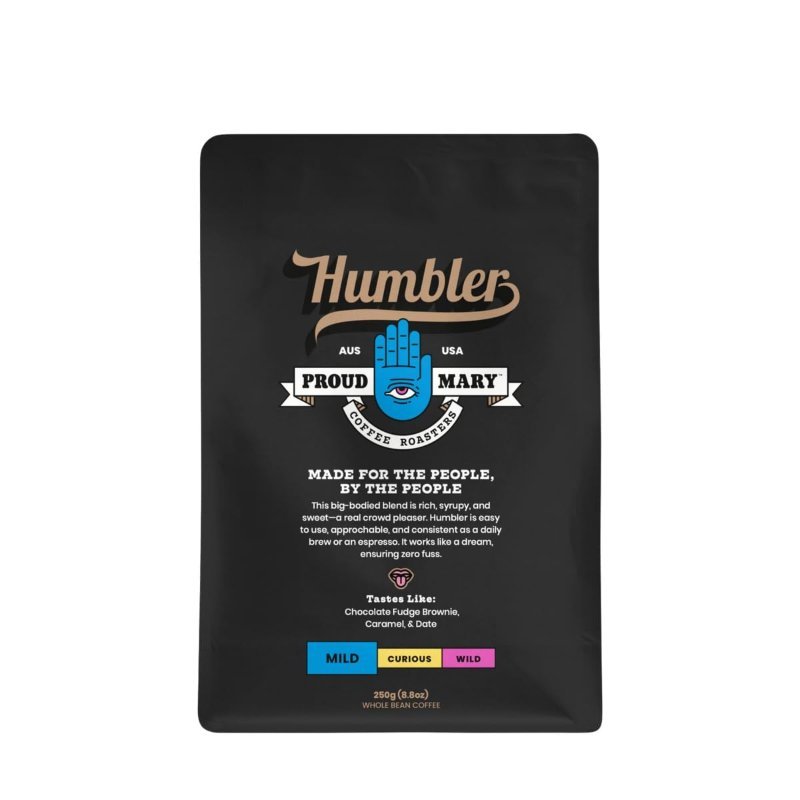
Their Humbler Blend is the sensible entry point: a 250-gram bag of whole-bean Brazilian coffee, roasted light and balanced, with tasting notes of caramel, date and chocolate. That profile is very much the Melbourne house style — sweet and legible rather than roasty, and forgiving enough that it won’t punish you for a sloppy pour. At around $1.94 an ounce it’s priced like ordinary specialty coffee rather than a novelty import, which is the whole point.
One caveat worth knowing: it’s a Brazilian blend, so if you’re hoping for the electric acidity of a Kenyan or an Ethiopian, this isn’t that. It’s the everyday bag, not the fireworks. Buy it as your morning default and go looking elsewhere for a showpiece.
The Melbourne Pick
Proud Mary Coffee — Humbler Blend, Whole Bean, 250g
Melbourne-founded, Portland-roasted. A light-and-balanced Brazilian blend with caramel, date and chocolate notes — the Melbourne house style, sweet and readable, at a normal specialty price. Your everyday bag, not your showpiece.
What Melbourne is actually worth copying
Not the flat white specifically, and not the roast profile. The transferable part is the expectation: that a café is judged on the coffee, that the person making it knows what they’re doing, and that a small well-made drink beats a large mediocre one. Melbourne didn’t build that with equipment. It built it by having a couple of generations of people who wouldn’t accept the alternative — which is why a very large company lost a hundred million dollars trying to convince them otherwise.