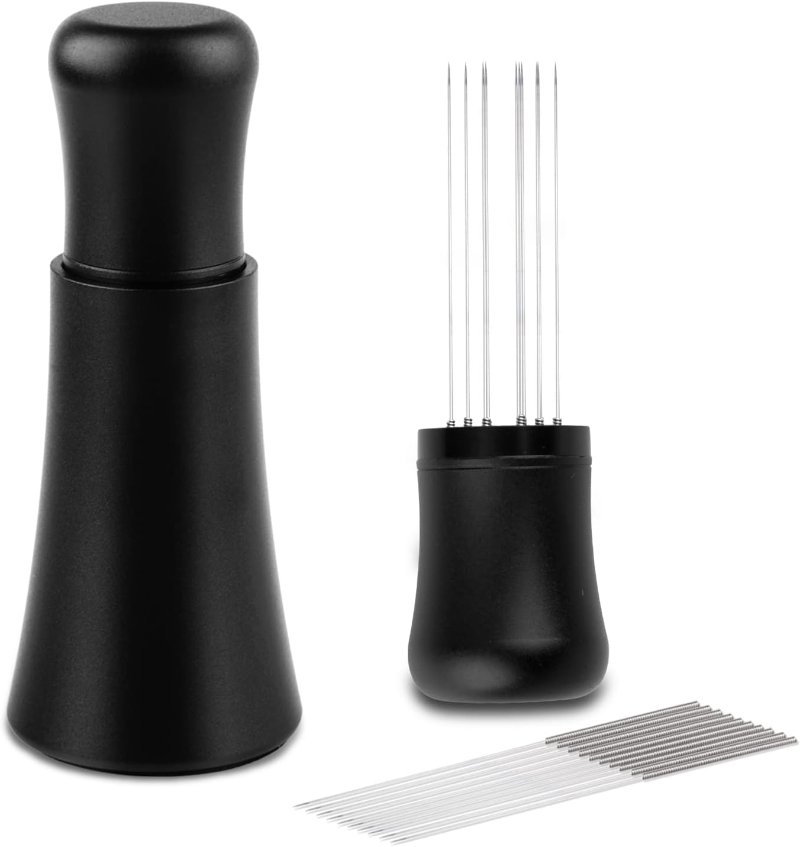
A WDT tool is a handle with a bundle of sewing-needle-thin wires sticking out of it. It costs about as much as two bags of decent coffee. It was designed for espresso, and it has been quietly migrating into pour-over setups for a few years now. The reasonable question is whether that migration makes any sense or whether pour-over people just like buying things.
Where the tool came from
The Weiss Distribution Technique is named for John Weiss, who worked it out in 2005 after noticing that home grinders clumped ground coffee badly enough to wreck espresso shots. His fix was blunt: stir the grounds with a thin needle before tamping, break the clumps up, and let water hit a uniform bed instead of a lumpy one. The commercial tools that followed are all variations on the same idea — usually five to ten stainless needles around 0.35mm, set in a handle.
None of that was ever about pour-over. Espresso runs nine bars of pressure through a puck about 20mm deep, so a dry clump becomes a channel, and a channel becomes a sour shot. The stakes are obvious there.
Why the clumping problem shows up in a cone too
Here is the part that gets skipped: clumping is a grinder problem, not an espresso problem. Static electricity and coffee fines cling together on the way out of the chute regardless of what you plan to brew. If you grind into a V60 and look closely, you will often see a bed that is half loose grounds and half pea-sized clods, especially with a light roast, a blade-adjacent burr set, or dry winter air.
A clump in a cone does not channel the way an espresso puck does, but it does hold a dry pocket. Water runs around it, and the inside of that clod extracts late and badly. In a V60 you have no pressure to fix this — your only agitation tools are the pour itself and whatever stirring you choose to do.
What it actually does when you use it
There are two separate ways people use one in pour-over, and they are worth separating because only one of them is really about the tool.
The first is dry stirring: grind into the dripper, run the needles through the bed a few times, level it out. This is where the tool has a real advantage over a spoon. A spoon shoves the bed around and piles grounds up the paper wall; ten thin needles pass through it and break clods without displacing much.
The second is the wet version — stirring during or just after the bloom. Barista Hustle’s testing on stirring the bloom in a V60 found it raised contact time by roughly ten seconds and extraction by about half a percentage point. That is a measurable improvement, and it is also a number worth sitting with for a second. Half a percent is not a different coffee. It is a slightly better version of the same one.
So: gimmick or not?
Not a gimmick, but badly oversold. Here is where I land after using one on a daily V60:
It earns its spot if your grinder clumps — older burrs, hand grinders with a lot of retention, or any setup where you can visibly see clods in the cone. It also earns it if you brew light roasts, which grind finer and clump more. In those cases the dry stir is doing real work that swirling cannot replicate.
It is close to pointless if you already stir or swirl your bloom with a spoon and your grounds come out fluffy. You have most of the benefit already, and the needles are just a tidier way to get there. Nobody has ever tasted the difference between a well-swirled bloom and a needle-stirred one in a blind cup.
What it definitely is not is a substitute for grind quality. If you are choosing between a WDT tool and putting that money toward a better burr set, buy the burrs. The tool patches a symptom of a mediocre grind; it does not produce a good one.
The one I would buy
Quick note: the link below is an affiliate link, so this site earns a small commission if you buy through it, at no extra cost to you.
These tools are close to a commodity — it is needles in a handle, and the $30 branded ones are not doing anything the $25 ones aren’t. The spec I would actually shop on is whether the needles come out. Ten needles is right for a dense 18g espresso puck; in a 20-gram pour-over bed at a coarser grind, ten is more drag than you need and the bed pushes around more than it should. Being able to pull four or five of them and run a sparser head is the difference between a tool built for espresso and one you can adapt to a cone.
WDT Tool, 10 x 0.35mm Stainless Needles with Aluminum Stand
Ten 304 stainless needles at 0.35mm, individually removable so you can drop to four or five for pour-over, plus ten spares and a stand that keeps the needles off your counter. Aluminum handle, no wobble. The removable needles are the reason this one works for cone brewing and most don’t.
The short version
Buy it if your grounds come out of the grinder in clumps. Skip it if they don’t. It is a small, real improvement that a lot of people have talked themselves into believing is a large one, and the honest test is simple: grind into your dripper tomorrow morning and look at the bed before you pour. If it looks like gravel, you don’t need this. If it looks like gravel with pebbles in it, you do.