Every bag of coffee you have ever bought traces back to a Red Sea port town that is now a fishing village with a war on its doorstep. Mocha — Al Mokha, Mokha, however you want to transliterate it — was the only place on earth you could buy coffee commercially for well over a century. Then Yemen lost the trade to colonial plantations in Java and the Americas, and the word “mocha” got demoted into a syrup you squirt into milk drinks.
So when a bag of actual Yemeni coffee shows up, there is a real question underneath the romance: is this good coffee, or is it a history lesson you are paying a premium to drink? I brewed through a bag to find out.
What “Mocha” actually means, before the syrup ruined it
Yemen was the first country to cultivate coffee commercially, starting in the 15th century, and for more than a hundred years the port of Mocha was the sole export point for the entire world supply. The name stuck to the beans that left through it. The chocolate association came later and separately — Yemeni naturals often carry a genuinely cocoa-like bitterness, and European traders started using “mocha” as shorthand for that flavor. The drink at your local cafe is a fourth-generation copy of a copy.
What makes Yemeni coffee distinct is not marketing. The growing conditions are close to absurd: terraced plots in highland desert west of Sana’a, minimal rainfall, brutal daytime sun, cold nights. Trees are old heirloom varietals that predate any modern breeding program, and nobody has done the varietal cataloguing that Ethiopia or Colombia have. Cherries ripen slowly and unevenly on stressed trees, which concentrates sugars and acids in a way irrigation-fed lowland coffee never does.
The processing is medieval, and that is the point
Nearly all Yemeni coffee is natural processed, not because anyone made a stylistic choice but because there is no water to spare for washing. Cherries dry whole on rooftops and stone terraces under direct sun. That is the oldest processing method there is, and it is also the least forgiving — a rooftop is not a raised bed, ferment happens unevenly, and defects sneak in.
The result is a cup that tastes nothing like the clean, bright African coffees people assume it should resemble given the geography. Expect dried fruit — date, fig, raisin — heavy body, low acidity, a bittersweet dark-chocolate spine, and a spiced, slightly wine-like rustiness through the finish. Some cups have a savory, almost tobacco edge. That rusticity is the house character of the origin, not a flaw to be roasted out.
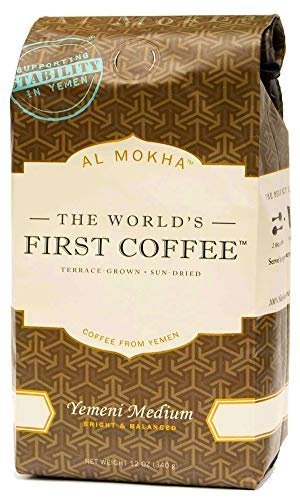
The bag: Al Mokha Yemen Medium Roast
Al Mokha is a small Washington, DC operation founded in 2013 by Anda Greeney, a former Air Force lieutenant who started the company as a graduate-school project at Harvard Extension and funded the first green purchase with $500 from a campus entrepreneurship competition. The premise was never “third wave darling” — Greeney has been explicit that he wants Yemeni coffee in the mainstream market, because volume is what actually pays farmers. Some of the company’s green passes through Rayyan Mill in Sana’a, a well-regarded operation on the quality side.
This section contains affiliate links. If you buy through them we earn a commission at no extra cost to you.
The medium roast is the right entry point for this origin. Yemeni naturals get muddy fast under a dark roast — the fruit collapses into generic bittersweet and you lose the thing you paid for. At a medium the dried-fruit and spice notes stay legible while the body remains substantial. It is not a delicate coffee and it is not trying to be. Grind it coarse-ish for pour-over, because the density and the natural process both push toward over-extraction if you crowd it. One update since this review ran: Al Mokha’s own bag has gone unavailable on Amazon with no restock date, which is what happens when your supply chain runs through a war zone. The notes below are still what that bag tasted like. The pick underneath it is the closest Yemeni bag you can actually buy today.
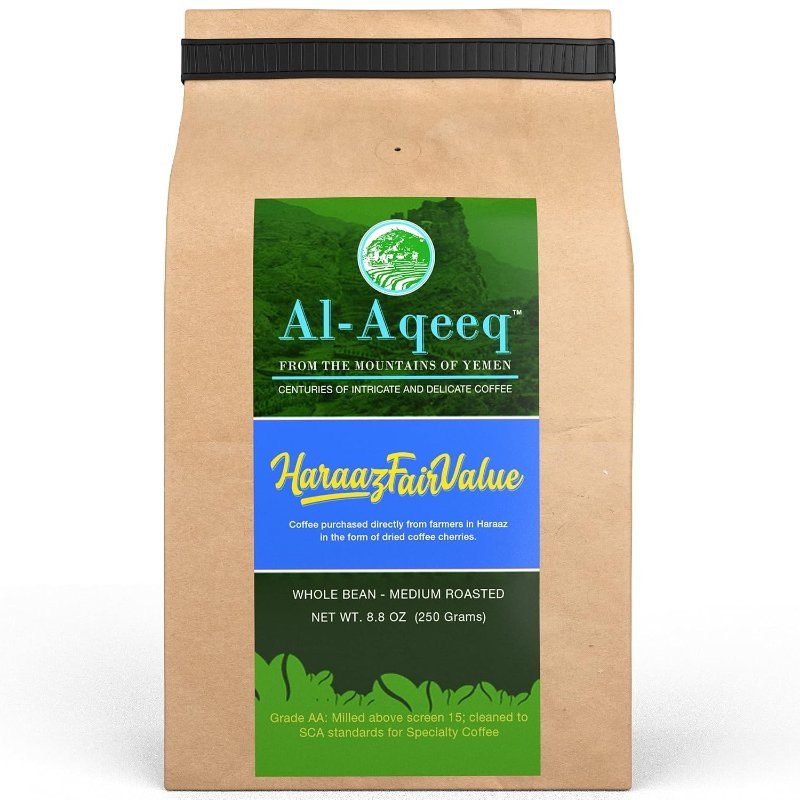
Al-Aqeeq Yemen Coffee, Haraaz Region — Medium Roast, Whole Bean
A different importer, the same country, the same highland terraces. Organic single-origin arabica out of Haraaz at a medium roast, so the dried fruit and spice survive the roaster. Not the bag reviewed above, and it will not taste identical — but it is Yemeni coffee you can put in a cone this week.
How I brewed it
V60, 22g to 360g water at 96°C, grind two clicks coarser than my usual Ethiopian setting, 45-second bloom. Total time landed around 3:15. The coarser grind matters more here than the water temperature — pulled at my normal setting the cup went astringent and hollow at the back end. Backing the grind off fixed it immediately.
It also takes milk better than most single origins, which is heresy to say on a pour-over site, but the chocolate-and-date profile survives dilution in a way a washed Kenyan simply does not. If you want to understand why Europeans built an entire drink category around the word, try it as a cortado once.
Is it worth the money?
Yemeni coffee is expensive per ounce, and it is worth being clear about why: tiny plots, hand-harvested on terraces, a supply chain running through an active conflict zone, and no economies of scale anywhere in the pipeline. You are not paying a specialty markup. You are paying what it costs.
Whether that math works for you depends on what you want. If your ideal cup is a bright, floral, tea-like light roast, this is not that, and you will probably think it is muddy. If you like Sumatra, big-bodied naturals, or anything with dried fruit and spice, this is the deepest version of that character available and there is genuinely no substitute — no other origin tastes like it. Buy an 8- or 12-ounce bag first rather than committing to a pound. It is a distinctive enough cup that you will know within three brews which camp you fall into.
Check the current price on the Al-Aqeeq Haraaz bag if you want to try the origin while Al Mokha’s own bag is out.