Ethiopia gets the credit for the coffee plant, and fair enough — arabica evolved wild in its highland forests. But a wild shrub isn’t a culture. Somebody had to work out that you could farm the thing on purpose, roast the seeds, brew them into something worth staying up for, and build an entire economy around the result. That somebody was Yemen, starting more than five centuries ago. Every café you’ve ever sat in is downstream of a handful of mountain monasteries on the Arabian Peninsula.
It Started With Monks Who Needed to Stay Awake
The first people we can confidently say drank coffee the way we do — roasted, ground, brewed hot — were Sufi monks in 15th-century Yemen. Members of the Shadhiliyya order used it to stay alert through midnight devotional prayers, and they called the drink qahwa. That word traveled better than almost any beverage name in history: it became kahve in Turkish, koffie in Dutch, and eventually the English word you’re reading this over. From the monasteries it spread through Mecca and Cairo, and by the 1500s the coffeehouse — a place to sit, argue, and drink the stuff socially — was a fixture of the Ottoman world. Yemen didn’t just grow coffee first. It invented the entire social ritual around it.
Mokha: The Port That Named Your Mocha
For roughly two hundred years, nearly every coffee bean that reached Europe, Persia, or the Ottoman Empire shipped out of one small Red Sea port: al-Makha, which English speakers flattened into Mocha. The name on your café menu is a leftover from that monopoly — the chocolate association came later, borrowed from the natural cocoa-like note in Yemeni coffee, not the other way around. The monopoly ended the way monopolies usually do: someone stole the product. In 1616 the Dutch trader Pieter van den Broecke smuggled live coffee plants out of Mokha, and Dutch plantings in Java (and later French plantings elsewhere) seeded the Typica and Bourbon lineages that nearly all cultivated arabica on Earth descends from. If you drink Colombian, Guatemalan, or Kenyan coffee, its family tree runs straight back through Yemen.
Terraces, Drought, and Heirloom Genetics
Yemeni coffee is still farmed the way it was centuries ago: on stone terraces cut into mountainsides at roughly 1,800 to 2,400 meters, in a climate most arabica would consider hostile. The plots are tiny and family-run, water is scarce, and the trees are old heirloom types — local farmers name varieties like Udaini, Dawairi, and Tuffahi — that spent five hundred years adapting in isolation from the rest of the coffee world. That isolation turned out to matter: genetic work published in 2020 identified a distinct population of arabica in Yemen, dubbed “Yemenia,” separate from the Typica and Bourbon groups everyone else grows. Processing is equally old-school. Whole cherries dry in the sun on rooftops — the natural process, practiced here before anyone needed a name for it — and the leftover husks get brewed into qishr, a spiced husk tea Yemenis have been drinking longer than most countries have been drinking coffee at all.
What It Actually Tastes Like, and a Bag to Start With
All of that history shows up in the cup. Yemeni naturals are wild by modern specialty standards: winey ferment, dried fruit, dark cocoa, a heavy body with an edge polished-washed coffees don’t have. We went deep on one specific bag in our review of Al Mokha’s Yemeni coffee, and that remains a great buy. But real Yemeni coffee is chronically expensive — war and logistics have made export brutally hard — so a lower-cost entry point matters. Quick disclosure: the link below is an affiliate link, and we earn a small commission if you buy through it, at no extra cost to you.
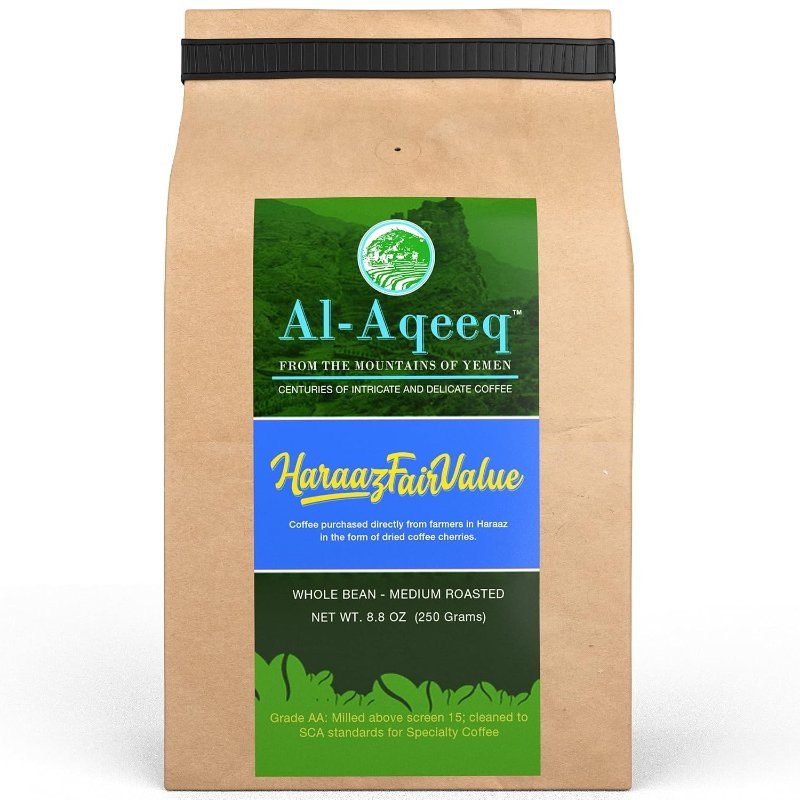
Al-Aqeeq’s Haraaz-region bag is the one we’d hand a first-timer. It’s single-origin organic arabica grown on the terraces of Yemen’s western highlands, roasted to a medium that leaves the dried-fruit and cocoa character intact instead of scorching it off, and it is the gentlest entry fee this origin offers.
Al-Aqeeq Yemen Coffee, Haraaz Region — Medium Roast, Whole Bean
Single-origin organic arabica from Haraaz, the terraced highland region that grows some of Yemen’s most sought-after coffee, at the friendliest price you’ll find in this category. Brew it as a pour-over and you’re tasting the oldest coffee culture on Earth.
One last reason to buy the real thing: Yemen’s coffee terraces survived five centuries of drought, empire, and war, but they won’t survive irrelevance. Every bag that sells is an argument for keeping the world’s first coffee farms in the coffee business.