Every piece of brewing advice you have ever read treats grind size as a single number. Go finer. Go coarser. Click two notches left. It is a useful shorthand and it is also wrong, because your grinder does not produce a size. It produces a spread, and the shape of that spread decides more about what lands in your cup than the setting you happened to stop on.
Your grinder makes a range, not a size
Pour-over lives in a fairly wide window — roughly 500 to 800 microns for flat-bottom brewers like a Kalita, and closer to 600 to 900 for conical ones like a V60. A micron is a thousandth of a millimeter, so we are talking about particles between half a millimeter and a millimeter across. Fine. Except that no grinder on earth hands you a bed of particles that size. What you actually get is a distribution running from near-dust all the way up to just under 2 mm, with the bulk of it clustered somewhere in the middle.
Two features of that curve show up in every measurement. The first is the fines fraction, conventionally everything under 100 microns. The second is stranger: most grind distributions show a secondary peak around 20 microns, which appears to be a natural size that coffee breaks into when larger fragments fracture along their internal weak lines. That peak is not a defect in your equipment. It is what happens when you shatter a plant cell wall, and no amount of money makes it disappear.
The extraction math is wildly lopsided
Here is the part that reframes everything. Surface area scales against volume, so a small particle gives up its soluble material enormously faster than a large one. A 100-micron fine will extract roughly eight times faster than an 800-micron boulder sitting next to it in the same bed.
Measured extraction yields make the gap concrete. In testing, particles below 250 microns climbed to a 22% extraction yield in just 15 seconds. The 250-to-500-micron group reached a little under 19% in that time. The boulders managed just over 14%. Those three numbers describe one brew. You are not running a single extraction at a single rate — you are running two or three simultaneously, and then drinking the average.
That is why a badly ground cup tastes confusingly bad rather than simply weak or simply harsh. The dust is already past 22% and throwing bitterness and astringency while the boulders are still sitting at 14% contributing sour, cereal-like under-development. You cannot fix that by adjusting your pour, because the problem is not the water. Technique variables like the bloom can only even out what the grinder gave you.
Fines carry about 70% of your surface area
This is the number worth remembering. Fines have very little volume — by weight they are nearly nothing — but they contribute roughly 70% of the total surface area in the bed. Almost all of their flavor is available to water instantly.
The practical consequence is that fines dominate your cup out of all proportion to how much coffee they represent. Researchers studying capsule extraction found that the “share of fines,” the volume fraction under 100 microns, predicted extraction time better than average particle size did. The dial setting is a weaker signal than the dust.
It also explains something counterintuitive: grinding finer does not slide the whole curve down neatly. It generates more fines at the same small sizes while shrinking how much the boulders contribute. So when you tighten your grind to chase more extraction, you are mostly buying more dust. And since fines migrate downward and pack into the filter, you get the second effect too — slower drawdown, longer contact time, more over-extraction on top of the over-extraction you already caused. Immersion brewing is more forgiving here for reasons I got into in the piece on immersion versus percolation.
Flat and conical burrs are different shapes, not better and worse
Flat burrs tend toward a tighter, more unimodal output — most of the mass clustered around one size. Conical burrs tend to produce a wider, more bimodal spread, with more fines and more boulders flanking the peak. Flat geometry generally reads as clarity and separation in the cup; conical reads as a rounder, heavier, more blended cup. Plenty of people prefer the second thing. Neither is a mistake, and the gap between the two burr shapes is much smaller than the gap between either one and a blade grinder, which does not cut at all and simply produces whatever your timing lands on. If that is still your situation, start with the burr upgrade argument rather than this article.
Alignment and wear, which nobody checks
Two mechanical things quietly widen your distribution no matter what you paid. Burr alignment is the first: burrs are supposed to sit parallel with a consistent gap, and when they do not, part of every rotation grinds finer and part grinds coarser. You get a wider spread from identical burrs purely because they are not sitting straight. The second is wear. Burrs dull with use, and dull burrs crush more than they slice, which produces more fines. A grinder that tasted tight two years ago and tastes muddy now may not need replacing — it may need burrs.
What this means when you are buying one
Specs rarely publish a particle-size curve, so you are reading proxies: burr size and material, how finely the adjustment steps, and whether the build holds the burrs steady. Below are three that do the proxy work honestly. Some of the links here are affiliate links, which means I may earn a commission if you buy through them at no extra cost to you.
If you grind by hand, resolution and repeatability are the whole game, and the KINGrinder K6 is unusually explicit about both. Its adjustment nut moves in 16-micron increments with 60 clicks per rotation across roughly four full rotations, which means you can actually describe your pour-over setting as a number and return to it next week. The full metal body and dual-bearing shaft matter more than they sound like they do — hand grinders lose consistency when the shaft can wobble under load, not when the burrs are bad.
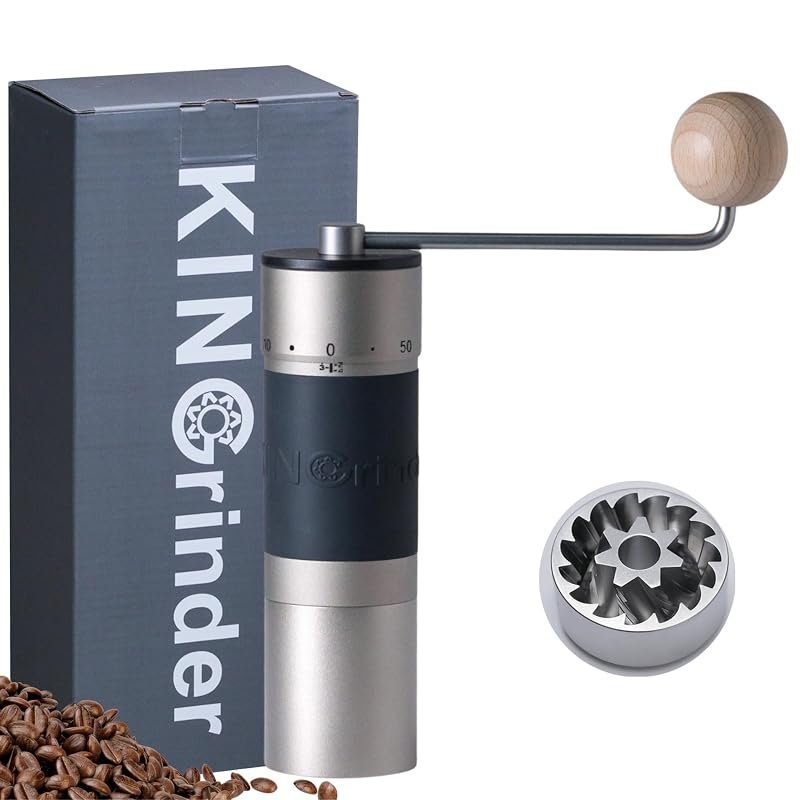
KINGrinder K6 Manual Coffee Grinder
16 microns per click, 60 clicks per rotation, stainless burrs and a dual-bearing shaft. The most precise way to spend this little.
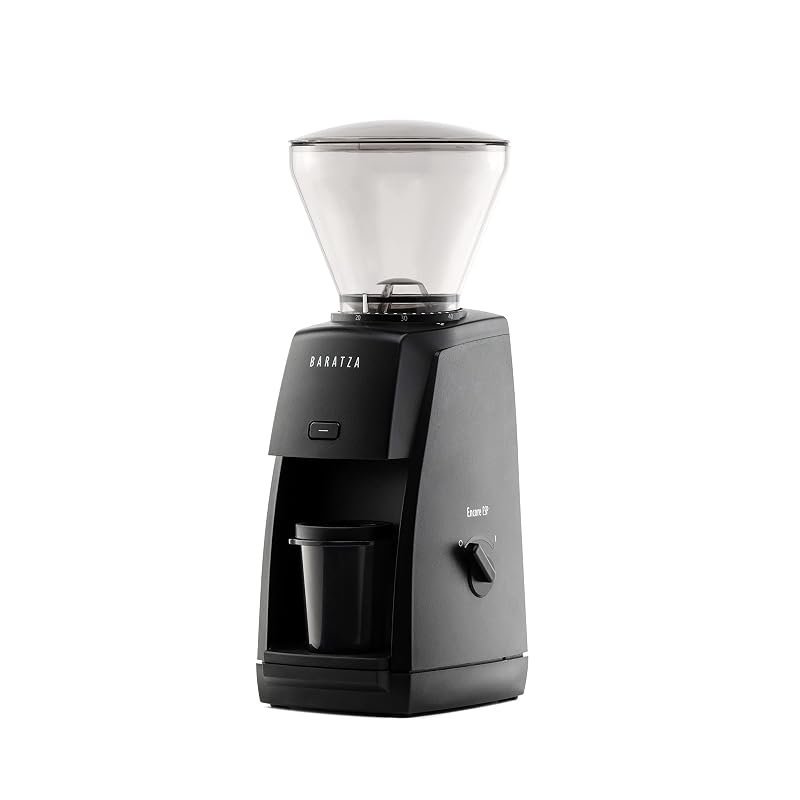
For an electric that will not fight you, the Baratza Encore ESP is where I would put the money. Its 40 mm conical steel burrs are a known quantity, and the dual-range adjustment is the useful part: settings 1–20 cover a fine micro range and 21–40 handle filter brewing, so the coarse end you actually use for pour-over gets real resolution instead of two usable clicks at the top of the dial. Baratza also still sells burrs and parts for its grinders, which is the sort of thing you stop treating as boring once yours is three years old.
Baratza Encore ESP Coffee Grinder
40 mm conical steel burrs, dual-range adjustment with real resolution at the filter end, and a company that sells replacement burrs.
If you want more steps to work with and a hopper you can load once, the Breville Smart Grinder Pro gives you 60 settings across hardened steel conical burrs, plus a hopper that holds close to a pound. The trade-off is that a big sealed hopper encourages you to keep beans sitting in it, which is its own problem. Use the top as a lid, not as storage.
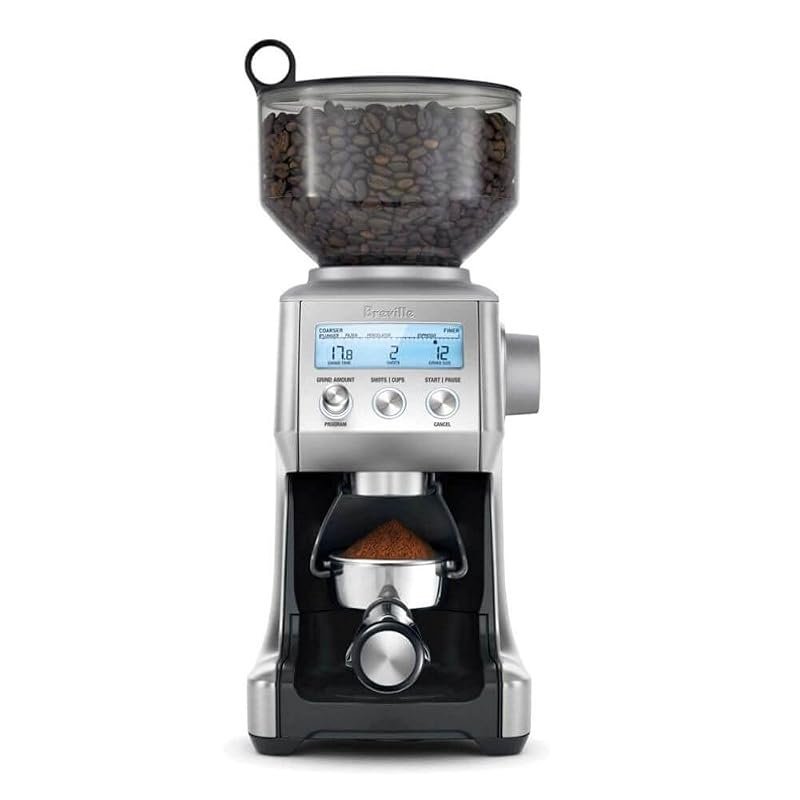
Breville Smart Grinder Pro
60 stepped settings on hardened conical burrs. The widest usable range here, if you do not mind the counter footprint.
The short version
Stop thinking about grind size as a number and start thinking about it as a width. Narrow the distribution and every other variable you fiddle with starts responding predictably, because you are finally brewing one coffee instead of three. That is the entire reason a better grinder changes your cup more than a better brewer does.