Almost everyone who gets into pour-over buys their shelf in the wrong order. The pattern is predictable: a handsome ceramic dripper, a gooseneck kettle in a colour that matches the kitchen, a bag of beans off the supermarket shelf, and a grinder bought last because it looked like the boring purchase. Three weeks later the coffee tastes thin and muddy at the same time, and the conclusion is that pour-over was oversold.
It wasn’t. The order was backwards. Pour-over punishes some corners you cut and shrugs at others, and sorting out which is which is most of the battle when you’re starting. Here’s the order I’d buy in, and the two things I’d deliberately leave off the shelf for a while.
The rule: spend where you can’t fake it
Several brewing variables cost nothing to control. Water temperature: boil the kettle, take the lid off, count to forty. Ratio: any kitchen scale gets you close enough to start. Pour speed is your hand, and it improves with practice whether or not your kettle cost sixty dollars.
Grind is the exception. It’s the one variable you cannot improvise around, cannot practise your way out of, and cannot repair downstream. If your grounds come out as a mix of boulders and dust, every cup is under-extracted and over-extracted at once, and no technique rescues it. We went through the mechanism in the only grinder upgrade that actually matters — briefly, blade grinders don’t grind, they smash, and the particle spread they leave behind is the largest single flavour problem in a beginner setup.
So the grinder goes first. Not second, not once you’re sure you’ll stick with it.
First: a hand grinder
A hand grinder is the right call at this stage for an unglamorous reason — your money buys burrs instead of a motor and a housing. A modest hand grinder carries burrs that an electric won’t match until you spend several times as much. The cost is thirty to sixty seconds of cranking per cup, which is less tedious than it sounds and more tedious than enthusiasts admit.
Some links below are affiliate links, which means we may earn a commission if you buy through them, at no extra cost to you.
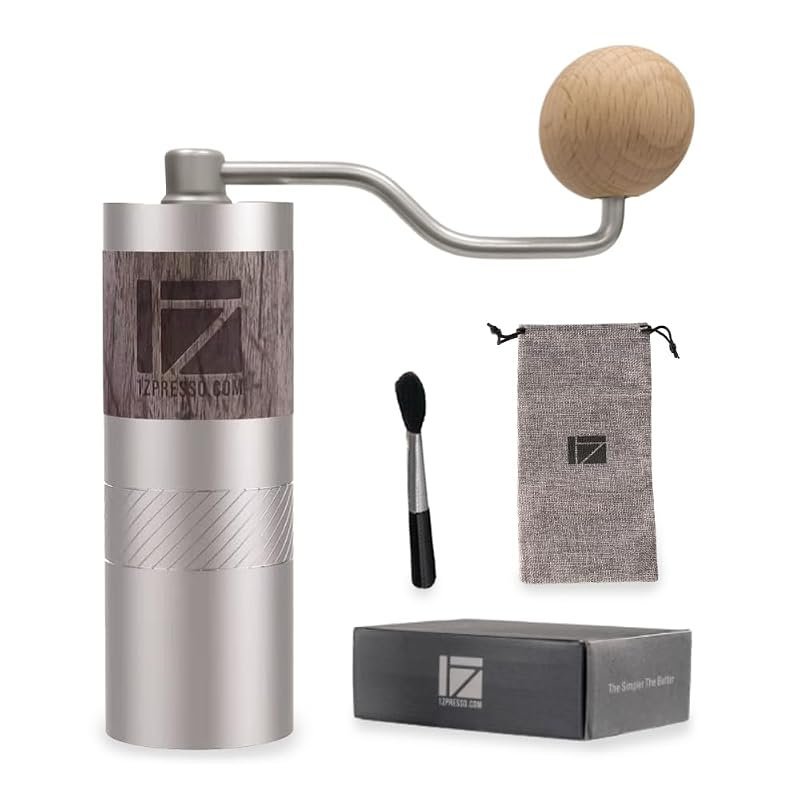
1Zpresso Q Manual Coffee Grinder
All-metal body on dual bearings with a triaxial shaft, and thirty clicks per rotation on the adjuster — fine enough to actually dial a V60 in rather than guess at it. It takes 15 to 20 grams, which is one generous mug or two modest ones, and it’s smaller than a soda can; it even stows inside an AeroPress plunger if you travel. That capacity is the honest limit: brew for two people every morning and you’ll be grinding twice.
Second: a dripper, a server, and the filters you’ll forget
Here’s the mistake that costs people a weekend: buying a dripper and no filters. A V60 cone takes a specific cone-shaped paper, and the supermarket does not carry it. Buy them in the same order.
On which dripper — get a plastic V60 in size 02. Not the ceramic, not yet; we compared the materials in glass vs ceramic vs plastic drippers, and plastic holds heat better than a cold ceramic cone while costing a fraction as much to replace when you sweep it off the counter. Size 02 is the size to own: Hario rates the 01 for one to two cups and the 02 for one to four, with a 116 mm mouth against the 01’s 95 mm. The 02 handles a single mug perfectly well and a second cup without a second brew.
The geometry is worth understanding, because it explains why a V60 forgives a clumsy pour. The cone is a 60-degree V — that is where the name comes from — so the bed sits deep and water converges toward the centre. The ribs spiral the full height to the top rim, holding an air gap between paper and plastic so the bloom can swell and gas can escape instead of the filter sealing itself against the wall. For the full comparison against a Chemex or a Kalita Wave, we ran that head-to-head; for a first dripper the V60 02 is the safe answer.
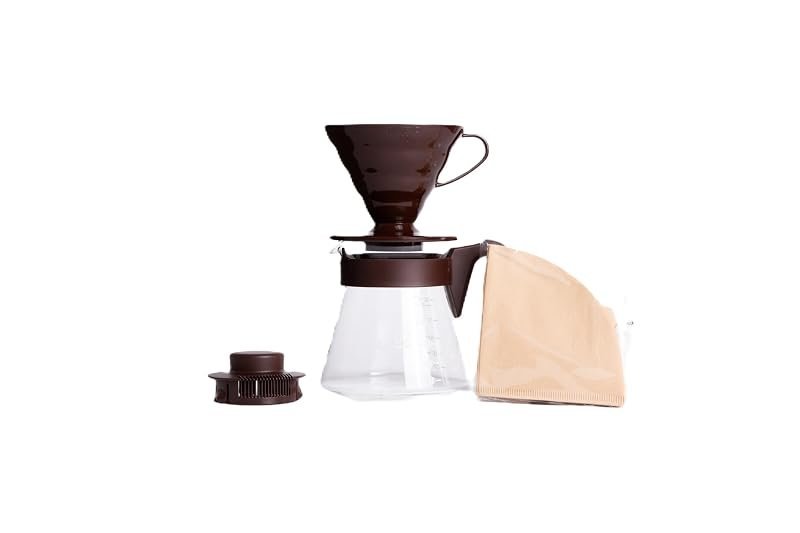
Hario V60 Pour Over Coffee Starter Set, Size 02
This set solves the filter problem for you: the 02 plastic dripper, a matching 02 glass server, and a 40-pack of papers in one box. The cone is AS resin, made in Japan, and takes a dishwasher without complaint. Forty filters is about six weeks at a cup a day, so put a 100-pack on the next order.
Third: a scale that also counts
You can brew without a scale, measuring with a tablespoon and watching the microwave clock. It works badly. The trouble isn’t accuracy so much as repeatability: with no numbers, you can’t tell whether this morning’s bitter cup came from too much coffee, too fine a grind, or a pour that ran ninety seconds long — so a bad brew teaches you nothing.
One device fixes that, and it costs less than the grinder: a flat scale reading to a tenth of a gram with a timer on the same face. Tenths matter less at pour-over doses than the spec sheets imply, but the built-in timer matters a great deal, because the alternative is operating a phone with wet hands.
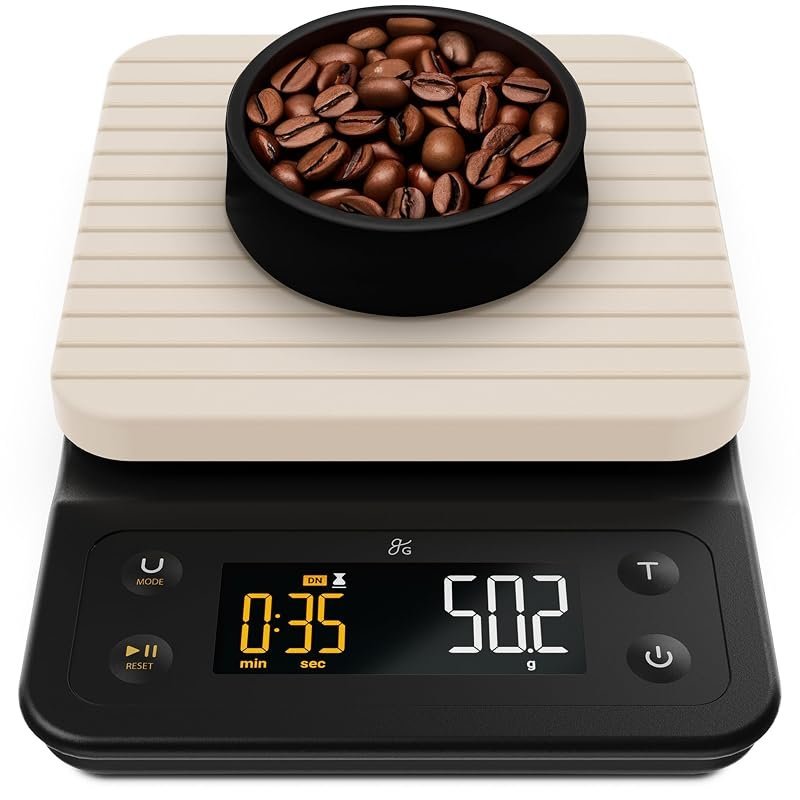
Greater Goods Coffee Scale with Timer
A 0.1-gram sensor, count-up and count-down timing on the same display, and a 5.25-inch square platform — wide enough to stand an 02 server on without the cone hanging off an edge. The silicone cover is the detail that pays off: pour-over means hot water next to electronics, and a washable heat-resistant top is the difference between a scale that lasts a year and one that lasts five.
What to leave off the shelf for now
Two things nearly everybody buys early and shouldn’t.
A gooseneck kettle. It’s a real improvement and you’ll want one eventually. It’s also the most postponable thing on the list, because a steady pour from any kettle with a narrowish spout — or a measuring jug, frankly — gets you most of the way there while your own hand is still the limiting factor. Buy it in month three, not week one. Our kettle guide will keep.
A storage canister. Beans arrive in a valved bag, and for the fortnight it takes to drink them that bag beats most canisters. Vacuum containers and freezer routines are a later-stage optimisation, and a fair amount of the usual advice about them is wrong — we sorted through it in eight coffee myths. For now, roll the bag down and clip it.
Three boxes, not nine
That’s the shelf: a grinder, a dripper set with filters, a scale. Three purchases in that order, and you can stop after any one of them and still be ahead of where you started. If you’d rather see the whole thing costed out as one build with alternatives in each slot, our under-$150 pour-over station does that. And if you’re buying for somebody else rather than yourself, the absolute-beginner gift guide is a gentler starting point than this list, which assumes you want to understand what you bought.