Vienna is the only city on this list where the coffee itself is arguably the least interesting part. That is not an insult. It is the whole point. UNESCO added Viennese coffee house culture to its Intangible Cultural Heritage inventory in 2011, and the inscription describes the coffee house as a place “where time and space are consumed, but only the coffee is found on the bill.” You are not paying for a cup. You are renting a marble table for as long as you want it.
So if you come to Vienna expecting Nordic light roasts and a barista narrating the fermentation protocol, you will be confused for about two days and then, if you have any sense, won’t care.
How Vienna Ended Up With 600 Coffee Houses
The origin story everyone repeats involves the 1683 Turkish siege and sacks of abandoned beans, and it is mostly legend. The more defensible version: Vienna’s first coffee house licence went to an Armenian named Johannes Diodato in the 1680s, and the habit spread from there through a city that already had an appetite for sitting around arguing.
The golden age came much later, around the fin de siècle, when roughly 600 coffee houses operated in the city. Stefan Zweig described the Viennese coffee house as a sort of democratic club, open to anyone for the price of a cheap cup, where a guest could sit for hours to talk, write, play cards, receive mail, and read an unlimited stack of newspapers. Freud, Klimt, Schiele, Adler, Loos, Herzl, Altenberg — they all had a house, and in Altenberg’s case the coffee house was more or less his mailing address.
The physical vocabulary is consistent enough to be a checklist: small marble-topped tables, bentwood Thonet chairs, newspapers clipped into wooden holders, and the coffee arriving on a small silver tray with a glass of water alongside it. The water is not a courtesy. It is a signal that you are welcome to stay, and in a proper house the waiter will quietly refill it.
The Drinks Are a Vocabulary Test
Ordering “a coffee” in Vienna gets you a raised eyebrow. The Melange is the workhorse — espresso-ish coffee with hot milk and a cap of foam, roughly a cappuccino with softer edges. A Kleiner Brauner is a small black coffee with a little jug of cream. An Einspänner arrives in a glass under a dome of whipped cream, historically so a carriage driver could hold the reins in one hand and drink with the other without the coffee going cold. A Fiaker adds rum.
Notice what is missing from that list: filter coffee. Vienna’s tradition is built around small, dark, milk-friendly coffee, which is exactly why the city’s classic blends behave the way they do in a V60.
What This Means for Your Dripper
Here is the part the travel writeups skip. Traditional Viennese house blends are darker, often contain robusta for crema and body, and are engineered to punch through milk. Brew one at your usual pour-over recipe and you will get something flat and a bit ashy. They are not bad coffees. They are coffees designed for a different job.
If you want to drink Vienna at home through a cone, two adjustments do most of the work. Grind a click or two coarser than you would for an Ethiopian, and drop your water to around 195°F. Dark roasts are more soluble and over-extract fast; the coarser grind and cooler water keep you on the right side of bitter. You will get chocolate, toasted nut, and a low rumbling body rather than florals, and that is the correct outcome.
Worth saying: Vienna also has a real modern specialty scene now — Jonas Reindl near the Schottentor tram stop roasts in small 10kg batches, and Kaffeefabrik in the 4th district roasts its own. Those beans behave like any other third-wave single origin. But they are hard to buy from the US, and they are not what the UNESCO listing is about.
Three Viennese Bags You Can Actually Order
Some links below are affiliate links, which means we may earn a commission if you buy through them — at no extra cost to you.
Julius Meinl is the obvious and, frankly, correct place to start. Julius Meinl I opened a spice shop in Vienna’s city center in 1862 selling green beans alongside cocoa and tea; his son industrialized roasting in 1877 with a process that kept coal gas off the beans, and by 1913 the company was the largest roaster in the Austro-Hungarian Empire. The red-fez Moor logo is on half the awnings in the city. If you have had coffee in Vienna, you have probably had Meinl.
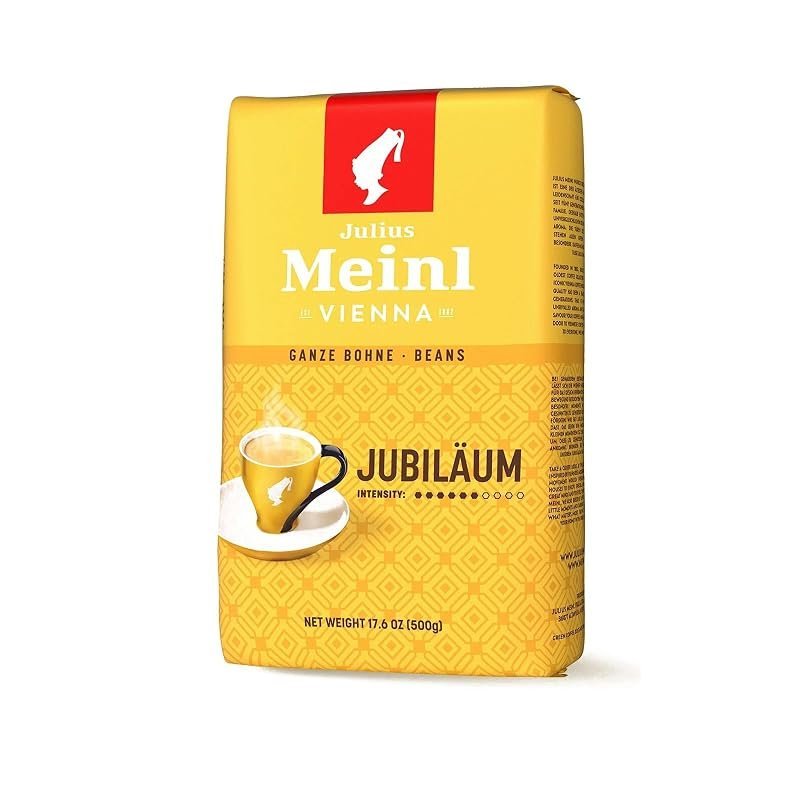
Start with the Jubiläum Blend, created in 1962 for the company’s hundredth anniversary and still the house standard. It is the most balanced of the three here and the one I would hand someone who wants to understand what a Melange is supposed to taste like. Whole bean, 500g, and the bag will last you a couple of weeks of daily drinking.
Julius Meinl Jubiläum Blend, Whole Bean 500g
The 1962 anniversary blend and the everyday Viennese house coffee. Medium roast, chocolate and toasted nut, built for milk but workable in a cone at 195°F and a coarser grind.
If you want the darker, more traditional end of the spectrum, the Präsident blend pulls from Central American, South American and Southeast Asian lots and lands heavier and lower-toned than the Jubiläum. Buy this one if you are making Einspänner at home, or if you take your coffee with cream and want something that does not disappear into it.
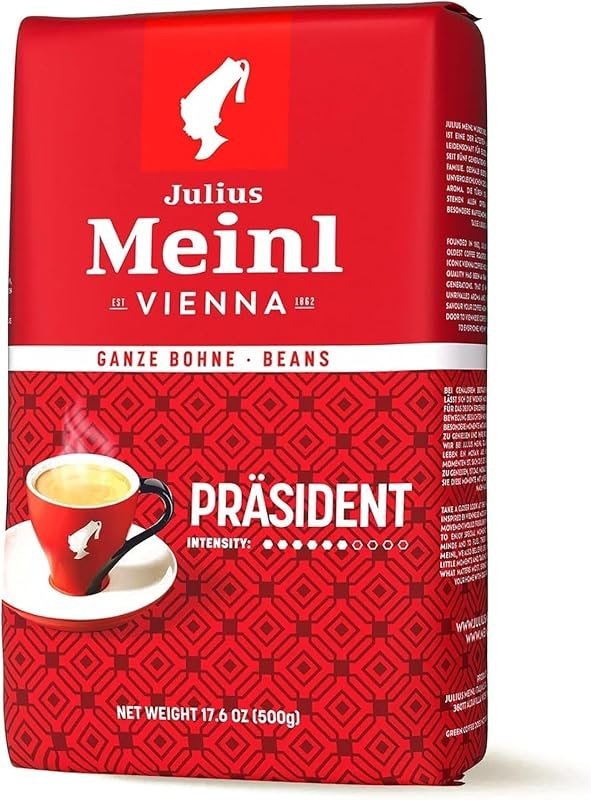
Julius Meinl Präsident, Whole Bean 500g
Heavier and lower-toned than the Jubiläum, blended across Central and South America and Southeast Asia. The pick for Melange, Einspänner, or anything with cream in it.
And if you own an espresso machine, skip the filter compromise entirely. The Espresso Arabica from the Premium Collection is 100% arabica, comes in a 1kg bag, and is the least awkward way to reproduce a Viennese café drink in your kitchen, because you are finally using the beans the way they were designed to be used. The kilo size also makes the per-cup cost reasonable if this becomes a habit.
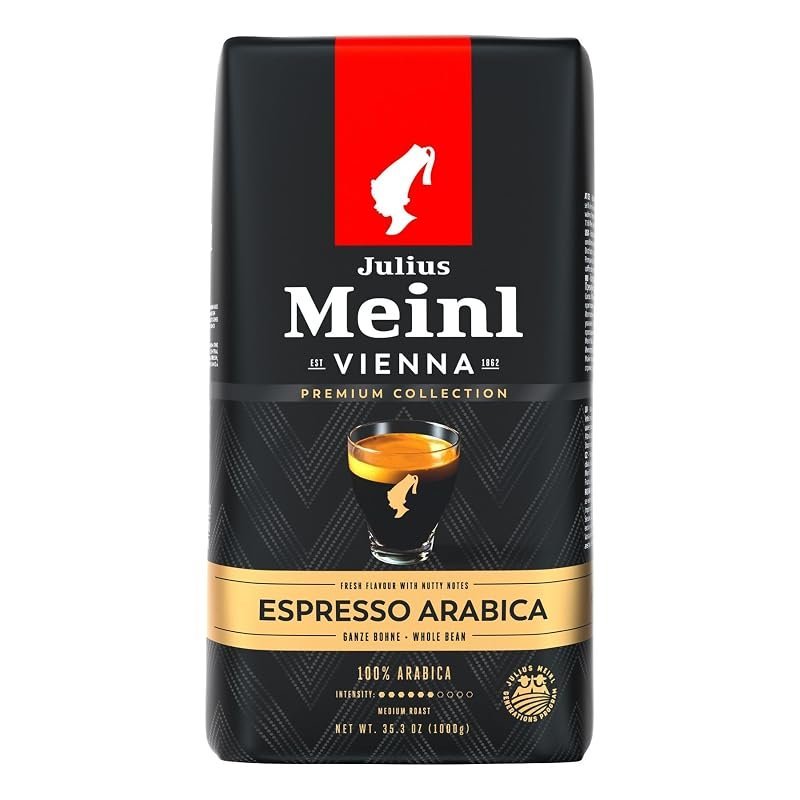
Julius Meinl Espresso Arabica, Whole Bean 1kg
100% arabica, imported from Vienna, in a kilo bag. If you have a machine, this is the shortest path to a real Melange and the best value of the three.
The Actual Lesson
Vienna is a useful corrective for anyone who has gotten a little precious about coffee. The city built a UNESCO-recognized culture around a medium-dark blend, a glass of tap water, and permission to sit still for three hours. The bean was never the point. Buy the Jubiläum, make it properly, and then — this is the important part — do not drink it standing at the counter.