Every coffee brewer you own is one of two things. Either the water sits in a pool with the grounds until you separate them, or the water moves through a bed of grounds and keeps going. That is it. French press, AeroPress, cold brew jar, Clever Dripper — immersion. V60, Chemex, Kalita, drip machine, espresso — percolation. Two categories, and the line between them explains most of why your French press and your V60 taste like different coffees even when you use the same beans, the same ratio and the same water.
This distinction gets treated as trivia. It is actually the most useful piece of brewing theory you can carry around, because it tells you which knob to reach for when a cup goes wrong.
The whole difference is what the water is doing
In immersion, the water you started with is the water you finish with. As coffee dissolves into it, that water gets steadily more concentrated — and the more concentrated it gets, the less aggressively it can pull anything else out of the grounds. Extraction starts fast and tapers toward a stall.
In percolation, the grounds are always meeting water that is close to clean. Fresh water enters at the top, picks up solubles, and leaves through the filter carrying them away. The bed never gets to sit in its own runoff.
The mechanism behind this is the concentration gradient — dissolved compounds move from high concentration to low, and the steeper the difference, the faster they move. Immersion flattens that gradient as it goes. Percolation keeps resetting it. This is why percolation is the more efficient of the two: typical immersion brews land somewhere around 18–21% extraction yield, while percolation brews tend to run 20–23%.
What immersion actually buys you
Efficiency is not the same as quality, and immersion wins on a different axis: it is far harder to screw up. Because the whole bed sits in the same water for the same amount of time, every particle gets roughly the same treatment. There is no channeling, no fast-draining edge of the bed, no dead spot in the middle. Grind unevenly and immersion mostly shrugs. Pour badly and there is no pour to speak of.
The result is a cup that reads as heavier and rounder, partly because most immersion brewers use a metal screen or no filter at all and let oils and fine particles through. It is also a cup that reflects the bean fairly faithfully — steep long enough and you get close to an honest average of everything in there, rather than a selective slice.
Some links below are affiliate links, which means we may earn a commission if you buy through them, at no extra cost to you.
If you want one immersion brewer to own, the argument is boring and correct: a good French press. The Bodum Chambord has been the default since the 1950s for a reason — borosilicate glass, a plunger assembly that comes apart for cleaning, and a 34oz size that makes enough for two people without a second brew. Skip the fancier plunger systems and the double-wall steel versions; the glass one lets you watch the bed, which matters more than you would think when you are learning what a stalled steep looks like.
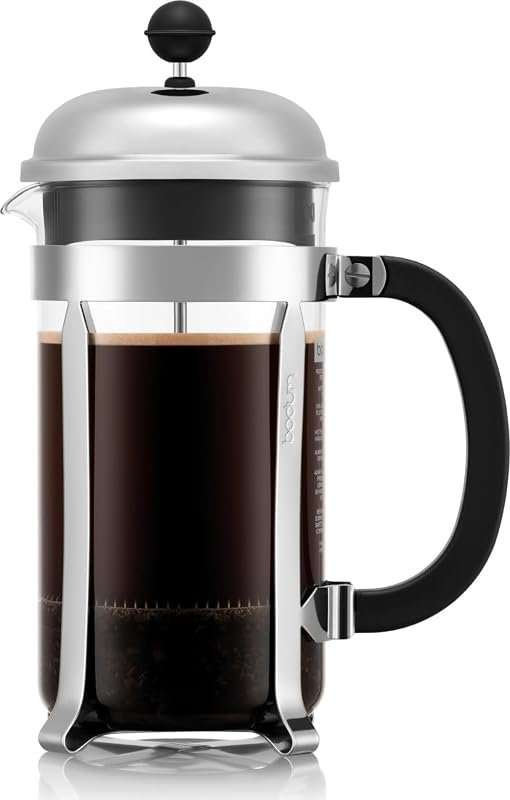
Bodum Chambord 34oz French Press
The unglamorous right answer. Forgiving of grind inconsistency, heavy-bodied output, and cheap enough that you are not precious about it. Use a coarse grind and four minutes.
What percolation buys you — and costs you
Percolation has the higher ceiling. That constantly-renewed gradient means you can reach extraction levels immersion cannot, and paper filtration strips oils and fines out, which is what produces that clean, tea-like clarity where individual flavor notes separate instead of blending. A well-executed Kenyan on a V60 tastes like blackcurrant and tomato as distinct things. The same coffee in a French press tastes like one merged, syrupy thing.
The cost is that percolation hands you more ways to fail. Water takes the path of least resistance through a bed of grounds, so an uneven grind or a sloppy pour creates channels — some coffee gets over-extracted while water races past the rest. Every pour-over technique fussed over online, from bloom timing to the WDT tool to spiral pouring, exists to fight that one problem.
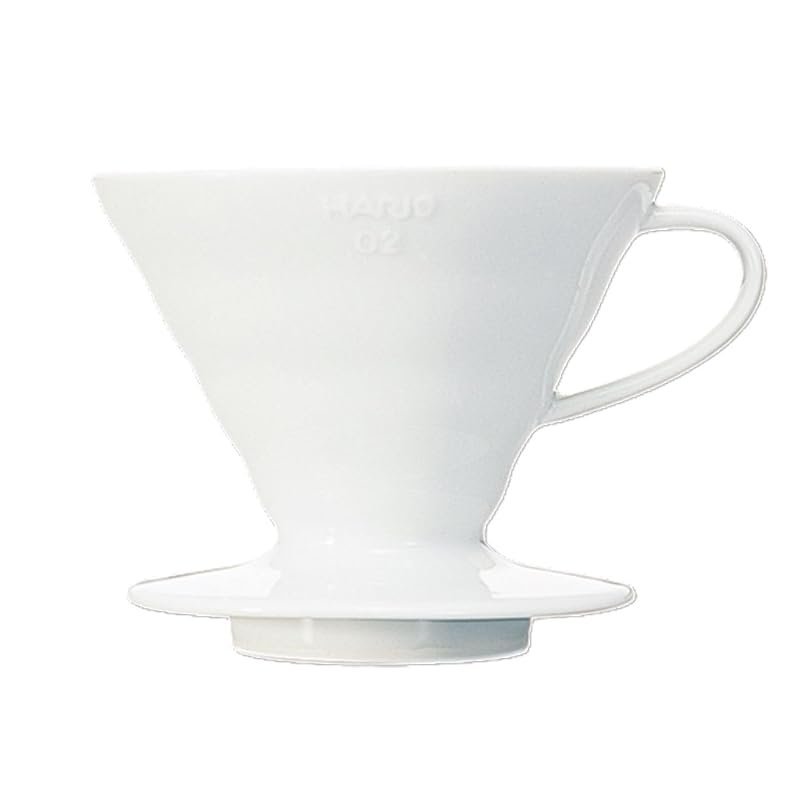
Hario V60 Ceramic Dripper, Size 02
The single large hole means flow rate is yours to control rather than the brewer’s. Ceramic holds heat better than the plastic version, which is the one real upgrade worth paying for here.
A wrinkle: the extraction numbers are not comparable
Here is where it gets interesting for anyone who has bought a refractometer and started chasing percentages. A 20% immersion brew and a 20% percolation brew do not taste alike, and there is a decent argument that the numbers themselves are measuring different things.
Scott Rao has made the case that when you calculate extraction on an immersion brew, you are crediting solids that dissolved into the liquid trapped inside the grounds — coffee that got extracted but never made it to your cup. Percolation flushes most of that through; immersion leaves it in the puck or the plunged bed. So the standard equation flatters immersion, and comparing the two numbers directly is closer to apples and oranges than most brew-ratio calculators let on.
Practical upshot: keep separate mental baselines. Do not try to hit your V60 target number on your French press and conclude something is broken.
The cheat: one brewer that does both
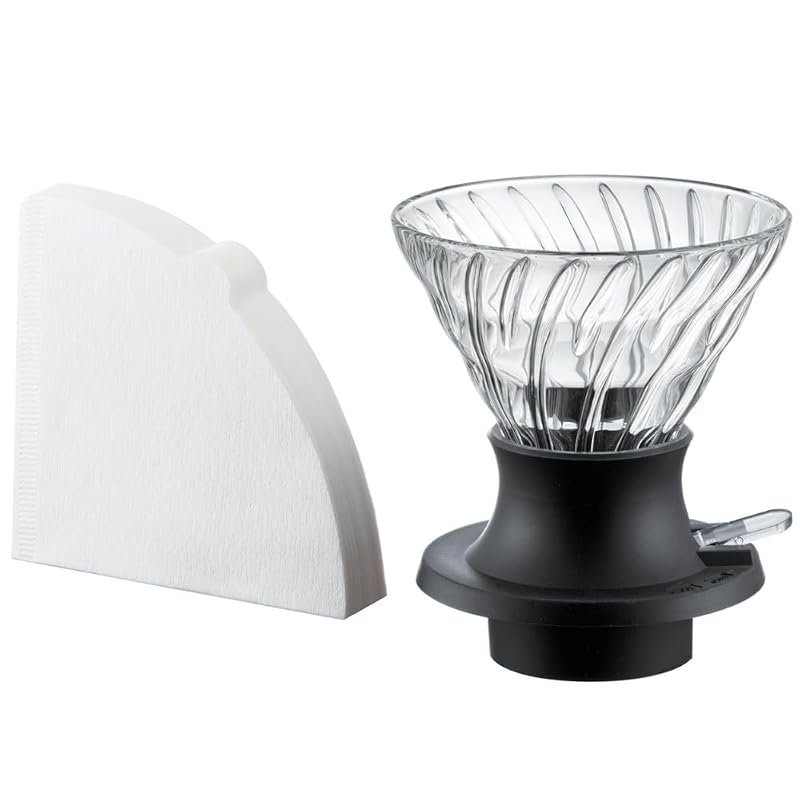
The most direct way to understand any of this is to brew the same coffee both ways back to back, which normally means owning two brewers and two sets of variables. The Hario Switch collapses that into one device — it is a V60 cone with a ball valve in the bottom. Valve closed, you have an immersion brewer that filters through paper when you open it. Valve open, you have a standard V60.
That combination is genuinely useful beyond the experiment, because it gives you paper-filtered clarity with immersion-style forgiveness — closed-valve steep, then release. It is the brewer I reach for with a coffee I have never met, before I know what grind it wants. If you only want to buy one thing after reading this, buy this one and run the comparison yourself; theory lands differently once you have tasted it.
Hario “Switch” Immersion Dripper, Size 02
A V60 with a valve. Brew immersion, percolation, or a hybrid steep-then-release on the same cone with the same filters. The most educational $60 in coffee gear.
How to actually taste the difference
Take one bag, ideally a bright washed African coffee where the differences are loud. Brew 20g at 1:16 in a French press, four minutes, coarse grind. Brew the same 20g at 1:16 on a V60, medium grind, two and a half to three minutes. Drink them side by side at the same temperature, which matters more than people admit.
The percolation cup will taste brighter, thinner and more separated. The immersion cup will taste rounder, heavier and more unified. Neither is the correct answer. But once you can identify which of the two you are drinking blind, you will stop guessing at fixes — you will know whether a dull cup needs a finer grind or a different brewer entirely.