Extraction percentage is the most intimidating-sounding number in home brewing and the least mysterious one. It is not a flavor score, not a quality rating, and not something a machine decides on your behalf. It is a weight ratio: of the dry coffee you put in the brewer, what fraction of its mass ended up dissolved in the liquid you drank? That is the whole concept. Everything built on top of it — the charts, the meters, the arguments — is bookkeeping.
The number is simpler than the jargon
The formula that turns a measurement into an extraction percentage is one line. As Perfect Daily Grind laid it out in November 2026, extraction yield equals the total dissolved solids reading multiplied by the weight of the finished beverage, divided by the weight of the dry dose.
Their worked example, from Malaysia Brewers Cup champion Shaun Liew: a 20-gram dose producing 300 grams of coffee at 1.30% dissolved solids comes out to roughly 19.5% extraction. Notice what just happened. Two of the three inputs — 20 grams and 300 grams — are weights. Any scale with tenth-of-a-gram resolution hands you both. Only the 1.30% needs an instrument you probably do not own.
Strength and extraction are not the same number
This is where most people get stuck, and it is worth slowing down for. Dissolved solids measure how concentrated the liquid in your cup is. Extraction measures how much of the bean you managed to remove. The two move together, but the relationship is fixed rather than identical: strength rises with the brew ratio and with extraction, both.
Which means a weak cup and an under-extracted cup are different problems with different fixes. You can hit a textbook 20% extraction and still produce something watery, if you simply used too much water for the coffee. You can also produce something aggressively strong and unpleasantly sour, which is a tight ratio papering over a bad extraction. Filter coffee typically lands between 1.15% and 1.45% dissolved solids; espresso runs 8% to 12%. Same extraction window, wildly different concentrations.
Your water belongs in this equation too, rather than acting as a neutral carrier — its mineral content changes how much the water can pull out of the grounds in the first place, which is a separate rabbit hole we went down in our bottled-water experiment.
Where 18 to 22 percent came from
The 18–22% target gets quoted like physics. It is closer to a committee decision that stuck. The figure usually appears as 20% give or take two, and it is the one piece of this that the brewing world broadly agrees on. The strength targets were never settled at all: the American standard asks for 1.15% to 1.35% dissolved solids, the European charts stretch to 1.20–1.45%, and the Norwegian standard sits higher still at 1.30% to 1.50%. The brew ratios follow — 55 grams of coffee per liter of water in the American version, up to 63 in the Norwegian.
That disagreement is informative. Extraction asks whether you pulled the right material out of the bean, and the answer turns out to be close to universal. Strength asks how strong you like it, and that is cultural. Norwegians drink it stronger. No chart is going to adjudicate that.
The charts themselves trace back to mid-century trade-funded research rather than any modern lab. The Coffee Brewing Institute, a trade organization in New York, took on its research director in 1955: Ernest Earl Lockhart, a Boston-born biochemist with three MIT degrees who had spent 1939 to 1941 as the physiologist on Byrd’s Antarctic expedition before turning to food technology. Coffee’s canonical brewing numbers come out of that institutional era — useful to keep in mind the next time someone quotes 18 to 22 at you as though it were handed down on tablets.
What that work produced is the brewing control chart, still in service: extraction percentage along the horizontal axis, strength up the vertical, and a radial line for each brew ratio cutting across the grid. Your cup is a dot on it. The chart tells you which way to move.
Two of the three numbers are just weights
Here is the practical consequence of that one-line formula. You cannot compute extraction without knowing your dose and your beverage weight to a sensible precision, and almost nobody measures the second one. People weigh their coffee and then eyeball the output, or they measure the water going in — which is a different number, because the spent grounds hold onto roughly twice their own dry weight in liquid that never reaches the cup.
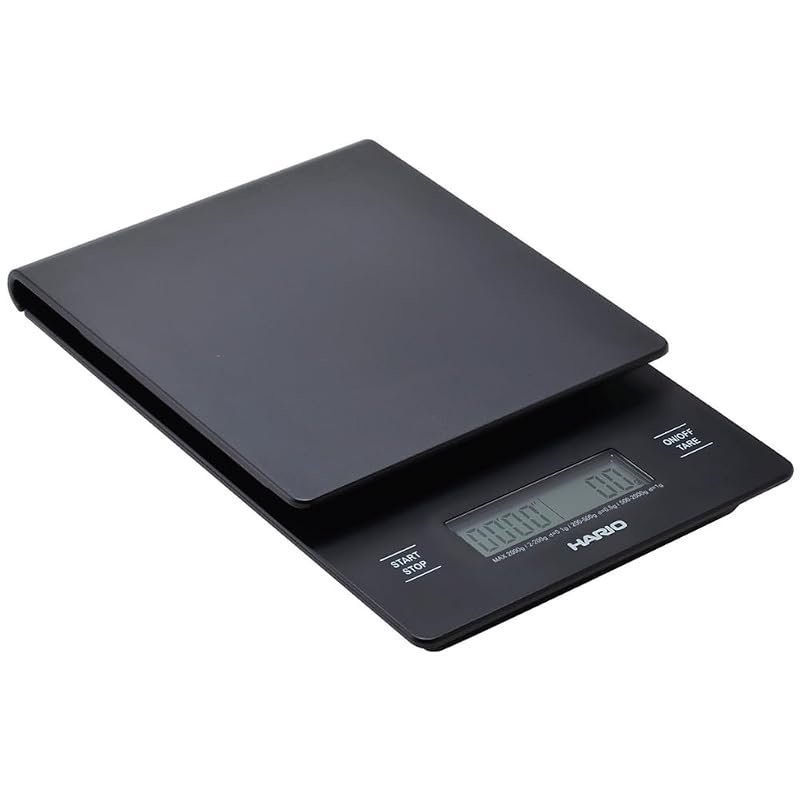
So before any of this becomes measurable you need a scale that reads to a tenth of a gram, sits under the brewer, and runs a timer so you are not juggling a phone. Low bar, unglamorous purchase, and the single piece of gear that makes every other number in this article possible.
The links below are affiliate links. If you buy through one, this site earns a commission at no extra cost to you.
Hario V60 Drip Scale
Tenth-of-a-gram resolution, a built-in timer, and a footprint that actually fits under a dripper with a carafe on top. Hario has been iterating on this for years, and the current version has dropped the irritating auto-off-mid-brew behaviour that plagued earlier drip scales. Weigh the dose, tare, brew onto it, and you have both numbers the extraction formula needs without doing anything extra.
The weigh-back method: extraction without a refractometer
Now the part nobody mentions: you can get your extraction percentage without ever buying a refractometer, and the method is arguably more trustworthy. It just takes two hours instead of ten seconds.
It works because refractometers are an approximation of something more fundamental. The reference method for measuring dissolved solids in any liquid is gravimetric — evaporate the water and weigh what is left. The EPA’s own standard method for total dissolved solids does exactly that, drying the residue at 180 °C. Meter-based readings are convenient substitutes, and conductivity-based ones land around 10% accuracy against the lab figure. Drying and weighing is the ground truth.
At home you run it backwards. Instead of weighing what dissolved, weigh what did not:
- Weigh the dry dose precisely — call it 20.00 grams. Weigh your dry paper filter separately and write that down too.
- Brew as normal.
- Scrape every bit of the spent puck into a foil tray, filter and all. Grounds clinging to the paper are coffee you dosed, so they come along.
- Dry it in a low oven, around 200 °F, weighing every half hour until the weight stops changing. Constant mass is the test, not the clock.
- Subtract the filter’s dry weight. If the grounds now read 16.2 grams, you dissolved 3.8 out of 20.00, and your extraction was about 19%.
The error sources are real and worth naming. Grounds left stuck in the brewer read as extraction that never happened and inflate your number. Stopping short of constant mass leaves water in the puck and deflates it. And a tenth of a gram of scale error on a 20-gram dose is half a percentage point of extraction — a quarter of the entire 18-to-22 window. A 0.1-gram brew scale is not precise enough for this one step.
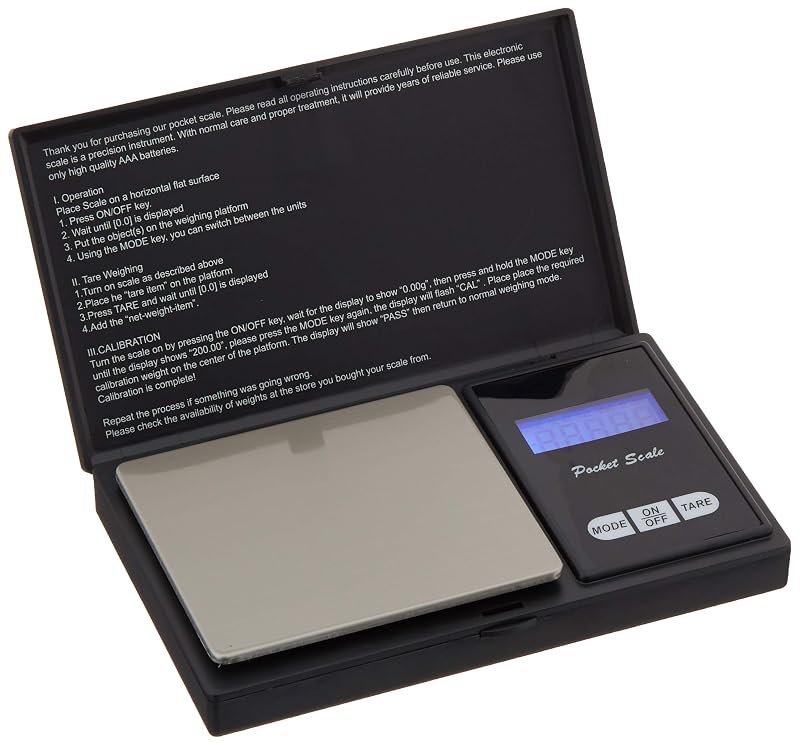
Digital Pocket Scale, 500g x 0.01g
Hundredth-of-a-gram resolution for about the price of two bags of coffee. You do not need it to brew — you need it for exactly this exercise, where a rounding error on your brew scale would swamp the measurement you are trying to take. It doubles as the scale to reach for if you ever want to weigh an espresso dose honestly.
Treat this as a calibration exercise rather than a habit. Run it three times on the recipe you brew every morning and you will know, with real confidence, where that recipe actually sits on the chart. From then on you can navigate by taste from a known position — which, it turns out, is what the measurement crowd is doing anyway.
The taste-first shortcut
You can get most of the way there with no instruments at all, as long as you learn to read two axes instead of one.
Under-extracted coffee is sour in a sharp, citric way, thin in the mouth, and finishes abruptly, often with a faint raw-grain or salty edge. Over-extracted coffee is drying and hollow, bitter toward the back of the throat, and lingers after you swallow in a way you do not enjoy.
The move that pays off is separating both of those from plain weak. If the cup tastes thin but sweet and balanced — nothing sour, nothing harsh, just not much of it — your extraction is fine and your ratio is not. Add coffee or subtract water. If the cup is strong and sour at once, the ratio is fine and the extraction is not: grind finer, and read why a couple of clicks on the grinder moves extraction so much before you overcorrect. And if the same recipe gives you a different answer every morning, the culprit is usually evenness rather than ratio or grind — water channelling past dry pockets of coffee, which is what the bloom step exists to prevent.
If you want to stop estimating
A refractometer measures the one number you cannot weigh, and that is its entire value proposition. It is also easier to misuse than the marketing lets on.
The caveats, per that Perfect Daily Grind piece: sample temperature is the largest single source of bad readings, so the sample has to stabilise before you measure it. Undissolved fines distort the result, so the sample wants filtering. The device wants zeroing against distilled water or your own brew water first. And the dose weight still has to be accurate, because it feeds straight into the calculation — a refractometer does not rescue you from needing a decent scale.
Shaun Liew’s framing is the one to adopt: do not start by chasing a number, start by learning to taste, then measure to explain the cup rather than to grade it. He treats his as a quality-control and training instrument, not a per-cup necessity. Refractometers are still not standard equipment outside quality-focused cafés, education programmes and competition tables.
We put one through its paces back in August and landed in a similar place — see the full writeup on whether a home refractometer is overkill. If you do want one, it is still the unit we would point at.
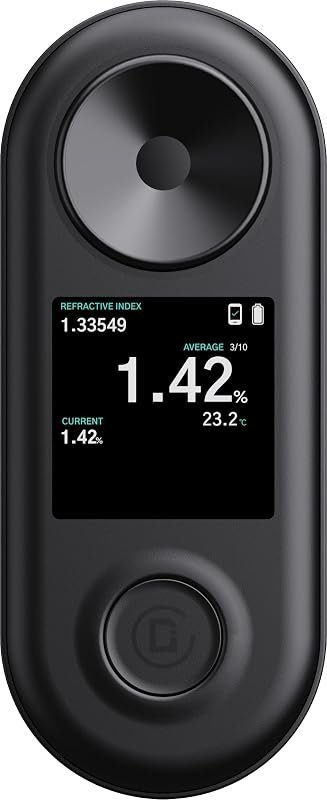
R2 Extract Digital Coffee TDS Refractometer
Reads dissolved solids directly, collapsing the oven exercise above into roughly ten seconds. Buy it for the reason a café would — confirming that today’s batch matches last week’s — rather than expecting it to improve your coffee on its own. It will not tell you anything your palate cannot, but it tells you faster and far more repeatably.
What to do tomorrow morning
Pick the recipe you brew most often. Weigh the dose, weigh what lands in the cup, write both down — you now hold two thirds of the equation and a baseline you did not have yesterday. Run the oven weigh-back once on a weekend to find out where that recipe really sits. Then put the spreadsheet away and taste, because the number was only ever a way of explaining what the cup had already told you.
Extraction percentage is a diagnostic, not a destination. The chart has a zone on it, not a bullseye.