Nobody buys a double-wall glass mug for thermal performance. You buy one because a light roast looks absurdly good suspended in clear glass, and because the mug appears to be floating inside itself. That is a perfectly good reason to own something. But there is real engineering in these, and almost everything people believe about it is slightly wrong — including the part where they are supposed to keep your coffee hot.
The second wall is not a vacuum, and that changes everything
The mental model most people carry over is the Thermos. James Dewar built the first vacuum flask in 1892 and declined to patent it; the design works because the space between its two walls is partially evacuated, which strips out most heat transfer by conduction and convection, and because the surfaces facing that gap are silvered to cut radiation.
A double-wall glass mug has two of those three things missing. The cavity is sealed but full of ordinary air, not evacuated, and nothing is silvered — silvering the gap is precisely what you are paying not to have, since the whole point is that you can see through it. Still air is a mediocre conductor, so the gap does slow conduction meaningfully. Radiation passes straight through. And the largest leak in any open vessel is the mouth, where there is no second wall at all.
So the honest description of what you get: the outside of the mug stays close to room temperature while the inside is near boiling. That is a real, useful property — you can wrap a hand around a fresh pour with no handle and no discomfort, and an iced drink will not sweat a ring onto the table. What you do not get is a cup that holds 200°F for half an hour. If anything, the thin inner wall and the wide-open top mean these cool at a rate not far off a thick ceramic mug, which at least has thermal mass working for it. If you want coffee hot at minute forty, you want a lidded steel vacuum tumbler and you want to stop reading.
Why borosilicate is the part that actually matters
Every mug worth buying in this category is borosilicate rather than ordinary soda-lime glass, and this is the specification to check before anything else. Borosilicate was developed by the German glassmaker Otto Schott in Jena in the late nineteenth century — it is the glass that later became Pyrex when Corning licensed the chemistry in 1915. The laboratory grade runs over 80% silica with roughly 12–13% boric oxide, and that boron is doing one specific job: it drops the coefficient of thermal expansion to about 3.3 × 10⁻⁶ K-1, roughly one third that of soda-lime glass.
In practice that means a borosilicate mug tolerates a temperature differential of around 330°F (166°C) without fracturing, where soda-lime glass gives up at about a 100°F swing. Pouring 205°F water into a mug that has been sitting in a 65°F kitchen is a 140°F differential. Soda-lime is already past its limit. Borosilicate is not close to its limit. That is the entire reason these can go straight from the dishwasher to a fresh brew without a preheat ritual, and it is the same material argument I went through in the glass vs. ceramic vs. plastic dripper comparison — borosilicate wins on thermal shock and loses on thermal mass, every time.
Two caveats the spec sheet will not give you. Borosilicate still cracks under rapid or uneven heating, so filling a cold mug a third of the way and leaving it is worse than filling it properly. And any chip or deep scratch becomes the starting point for a failure later, which is why a mug that has been rattling against cutlery in a dishwasher basket for two years is not the mug it was when you bought it.
The things that actually annoy you day to day
Three complaints come up with every one of these, across every brand, and none of them are on the box.
Water gets inside the wall. Most of these mugs have a tiny vent hole in the base, usually plugged with silicone, because the sealed cavity needs somewhere to equalise during manufacture. If that plug fails or the seam weeps, water works its way into the gap and will not come out, and you now own a cloudy mug with a permanent puddle in it. This is the single most common way these die. Inverting them to dry rather than leaving them upright in a rack helps.
The stated capacity lies about the size. A 12 oz double-wall mug is the exterior footprint of a 16 oz single-wall one, because two walls plus an air gap eats somewhere around a centimetre of radius. If you are used to filling a big diner mug, size up a tier.
Handle or no handle is not a style question. The handle-less tumbler shape is the prettier object and it works, because the outer wall really does stay cool. But it also means every pickup is a full-palm grip, which is fine for a cappuccino and irritating for a long black you are sipping at a desk for twenty minutes. I would rather have the handle and accept the uglier silhouette.
The three sets worth owning
Picks below are Amazon affiliate links, so a purchase through one earns this site a commission at no cost to you. All three are borosilicate and all three are currently in stock.
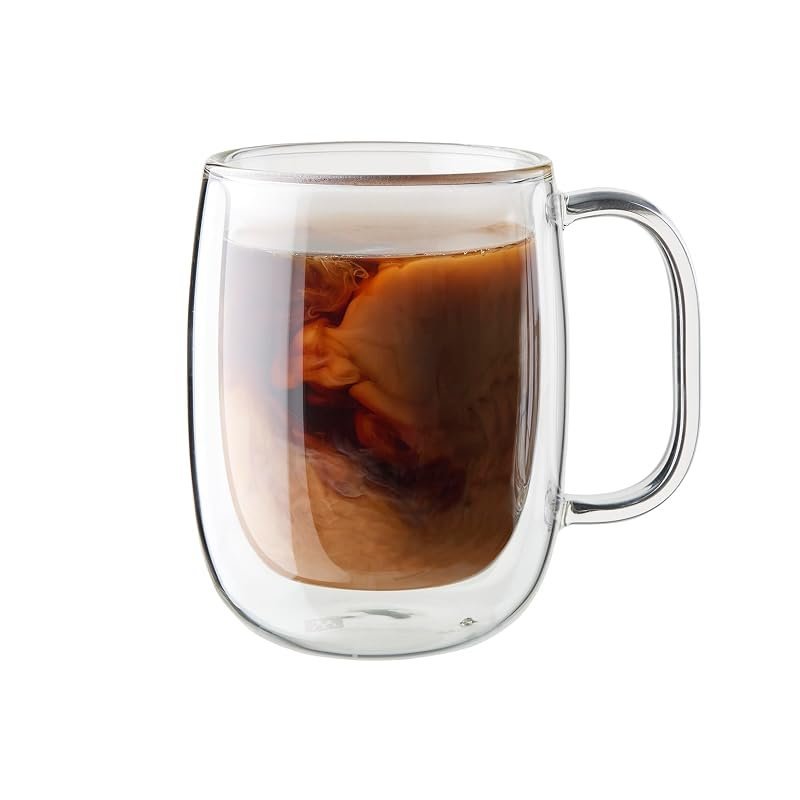
If you want one recommendation and no deliberation, take the Zwilling. The Sorrento Plus is the best-built handled double-wall mug in reach of a normal budget: the handle is a properly formed pulled loop rather than a glued-on afterthought, the wall thickness is even enough that the floating-interior illusion reads cleanly, and the 12 oz size is right for a double shot plus milk or a standard pour-over serving. It is the set I would put in a cabinet I expected to use every morning.
Zwilling Sorrento Plus 2-Pc, 12 oz Coffee Mug Set
Handled, borosilicate, 12 oz, two to a box. The best fit and finish at a price that is not silly, and the handle solves the one real ergonomic flaw in the category.
The Bodum Pavina is the benchmark object and deserves the shelf space even though it is the wrong shape for coffee. This is the 0.35 L / 12 oz pair that essentially defined what a double-wall glass looks like, and the proportions are better than anything copying it. No handle, so it is at its best with a flat white, an espresso over ice, or anything you drink in under ten minutes. Buy these as the second set rather than the only set.
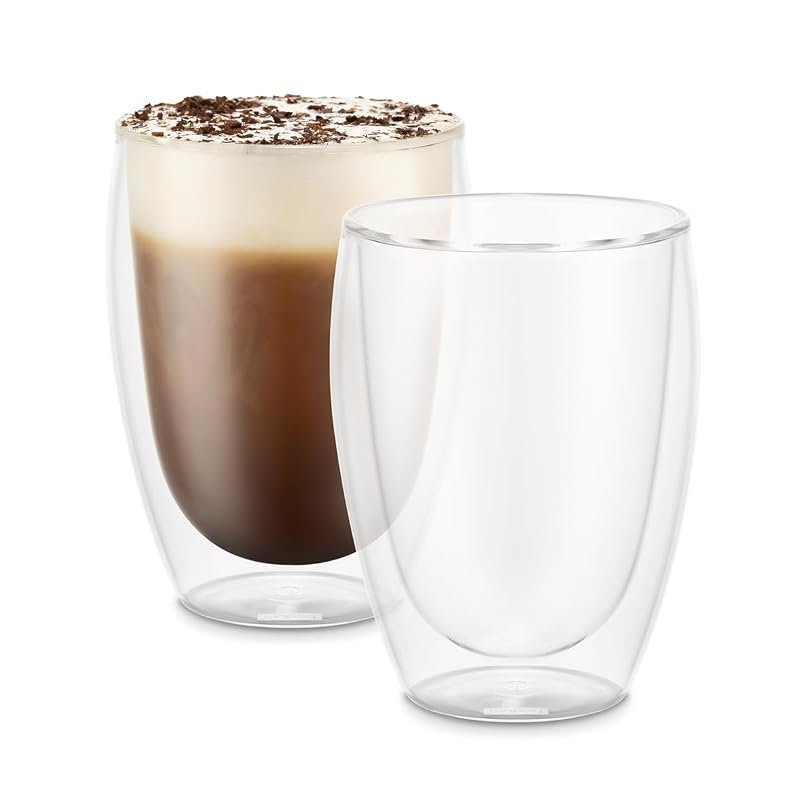
Bodum 4559-10 Pavina Double-Walled Thermo Glasses, 0.35 L / 12 oz, Pair
The original, and still the best-looking. Handle-less tumbler shape — superb for short drinks, less good for a slow desk coffee.
And if you are buying these to see whether you like them at all, or you have housemates who break things, the JoyJolt Savor set is the sane entry point. Thicker glass than the Bodum, a handle, 13.5 oz so it actually holds a full mug, and a price that makes a breakage an annoyance rather than an event. Fit and finish is a step down — seams are more visible and the wall thickness varies between units — but the material and the physics are the same.
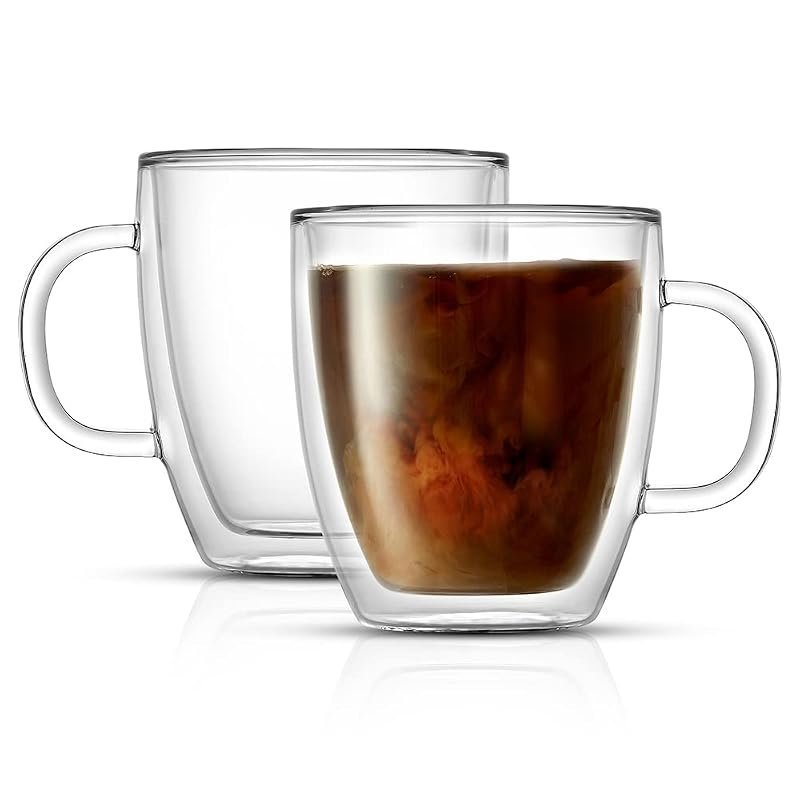
JoyJolt Savor Double Wall Insulated Glasses, Coffee Mugs, Set of 2, 13.5 oz
Handled, 13.5 oz, cheap enough to be casual about. The largest capacity of the three and the one to start with if you are unsure.
Buy them for the right reason
Buy double-wall glass because you want to look at your coffee and hold a hot cup bare-handed, and because borosilicate shrugs off thermal shock that would crack a cheaper glass. Do not buy it as insulation. Treat the vent plug as the weak point, dry them upside down, keep them out of a crowded dishwasher basket, and a set will last years. If your glassware shelf is still being built out, the two other pieces I would put ahead of these are a decent glass carafe and a proper sealed canister for beans — both do more for the coffee itself than the vessel you drink it out of.