Brazil is the coffee equivalent of a country that quietly supplies half the world’s screws. Nobody frames a bag of Brazilian coffee as a trophy the way they do an Ethiopian natural or a Panama Geisha, and yet pull almost any espresso blend off a shelf and Brazil is in there doing the structural work.
The scale is hard to picture until you put numbers on it, so let’s do that first and then talk about what it means for what you actually taste.
The number, and what it actually is
For the 2026/27 crop year, the USDA’s Foreign Agricultural Service puts Brazil at 71.9 million 60-kilogram bags — a record, and a rebound of about 8.9 million bags (roughly 14 percent) over the 63 million estimated for 2025/26. World production for the same year is pegged at 189.7 million bags.
Do that division and Brazil is a shade under 38 percent of global supply. “A third” is the number everyone repeats, and it undersells it. Brazil also expects to export about 45 million bags of green coffee this year. There is no second country in this conversation.
Brazil is two coffee countries wearing one trench coat
That 71.9 million splits almost exactly two-to-one: 47.5 million bags of arabica and 24.4 million bags of conilon, Brazil’s name for robusta. Those two crops barely overlap geographically. More than 70 percent of the arabica grows in Minas Gerais, inland and elevated. Around 70 percent of the conilon comes from Espírito Santo, the humid coastal state to the east.
So when someone says “Brazilian coffee,” they are talking about one of two completely different products. The conilon mostly disappears into instant coffee and commodity blends; the arabica is what lands in your grinder. If the arabica-versus-robusta distinction is fuzzy for you, we went deep on it in why some farms are switching from arabica to robusta rather than re-litigating it here.
One more wrinkle worth knowing: conilon had a mildly rough year. Cooler temperatures and heavy rainfall in Espírito Santo pulled yields down about 600,000 bags even as arabica surged. The two halves of Brazil’s crop do not move together.
Flat ground is the whole story
Here is the thing that separates Brazil from every other major origin, and it is not a soil mineral or a heirloom varietal. It is topography. Brazilian coffee largely grows on flat or gently rolling land, planted in long straight rows, which means it can be harvested by machine.
Almost nowhere else can do this. Colombian and Ethiopian coffee grows on slopes where the only viable harvester is a person with a basket. Brazil’s farms run mechanical harvesters that straddle the rows, and smaller operations use a derriçadeira — a handheld vibrating rake that shakes cherries onto a tarp spread under the tree.
Historically this meant strip-picking: everything comes off the branch at once, ripe cherries alongside green ones and overripe ones. That is the single biggest reason commodity Brazilian coffee earned a reputation for being flat and woody. Modern harvesters are considerably better — they can be tuned to shake loose only fully ripe fruit — but the economics still favor volume over selectivity in a way that hand-picked origins don’t.
Low altitude, low acidity — and that is a feature
Brazilian arabica mostly grows between roughly 800 and 1,200 meters. A representative Sul de Minas lot sits around 950 meters. Compare that to Guatemalan Antigua or Kenyan coffee at 1,600 to 2,000-plus, and the flavor difference stops being mysterious.
Altitude slows cherry maturation, which builds the dense beans and sharp organic acids that give high-grown coffee its brightness. We walked through that mechanism in detail in the piece on Guatemala’s volcanic highlands. Brazil sits lower, ripens faster, and produces beans that are softer, sweeter, and markedly less acidic.
If you have spent time with Kenyan coffee and its blackcurrant electricity, Brazilian coffee will read as almost sleepy by comparison. That is the trade. What you get instead is body, chocolate, roasted nuts, and a cup that does not turn sour when you under-extract it slightly. It is the most forgiving coffee in the world, which is exactly why it anchors so many espresso blends — it will not fall apart on you.
Natural process is the default here, not a specialty flex
In most of the specialty world, a natural-processed coffee is a deliberate, slightly showy choice. In Brazil it is just how coffee gets made, because the climate during the April-to-September harvest is dry enough to let cherries dry whole on patios without fermenting into vinegar.
There is also a hybrid Brazil leans on heavily: pulped natural, or cereja descascado. The cherry skin gets pulped off but the sticky mucilage stays on the parchment, which is then dried in thin layers on patios and turned frequently for even drying. You get some of the sweetness and body of a natural with more consistency than full-cherry drying allows.
This is the same principle we unpacked in why Sumatran coffee tastes nothing like the rest of Indonesia: processing choices made for local climate reasons end up defining how an entire origin tastes.
“Santos” is a port, not a farm
Nearly every Brazilian bag you can buy online says Santos on it. Santos is a city on the São Paulo coast and Brazil’s busiest coffee port — it is a shipping term that stuck, the way “Mocha” stuck to Yemeni coffee. It tells you a coffee was exported through Santos and graded to a certain cleanliness standard. It does not tell you the farm, the varietal, or the altitude.
That is not a scam, just a limit. Santos-grade coffee is a reliable commodity benchmark, and when it is roasted fresh it can be very good. But if a bag tells you nothing beyond “Santos,” adjust your expectations toward consistent and pleasant rather than distinctive.
What to actually buy
Three bags below, each illustrating a different point from the article. These are affiliate links — if you buy through them the site earns a commission at no cost to you.
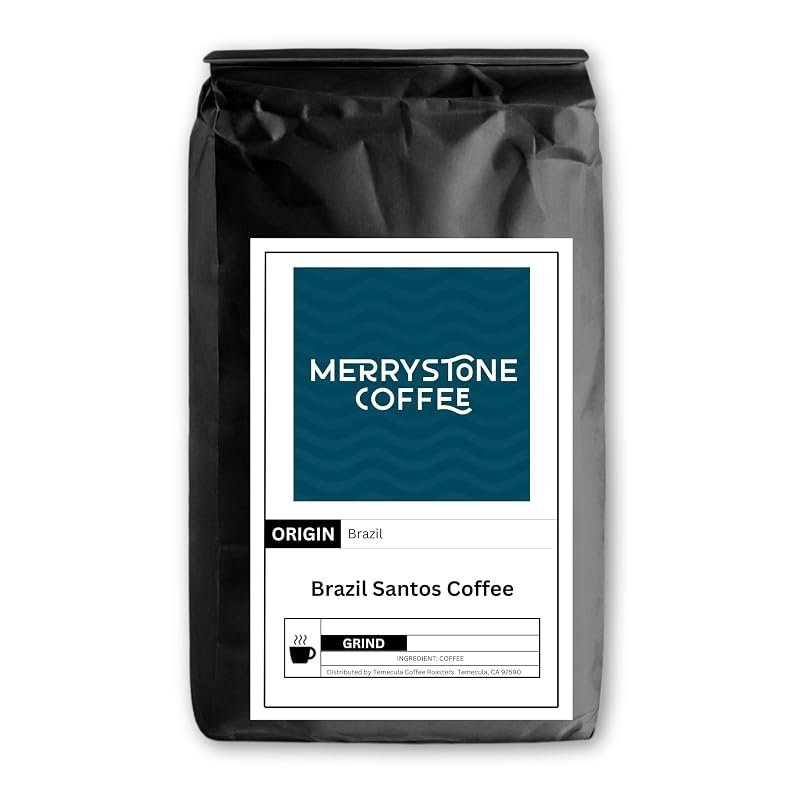
Start here if you want the archetype. Merrystone’s Santos is the Brazilian cup in its most recognizable form: medium roast, low acid, cocoa and toasted nuts, roasted to order. It is the bag to buy if you want to taste what people mean when they say “Brazilian” — and it doubles as an excellent moka pot and espresso base for exactly the forgiving reasons described above.
Merrystone Coffee Brazil Santos, 12 oz Whole Bean
Single-origin Santos arabica, medium roast, small-batch roasted after you order. Smooth, low-acid, cocoa-and-nuts. The clearest example of the house style.
If you want to taste the processing, not just the origin. Cubico’s bag leans explicitly on natural processing, which is where Brazil’s fruit sweetness and heavier body come from. Brew this one side by side with a washed Central American and the difference in mouthfeel will be more obvious than any tasting note on either bag.
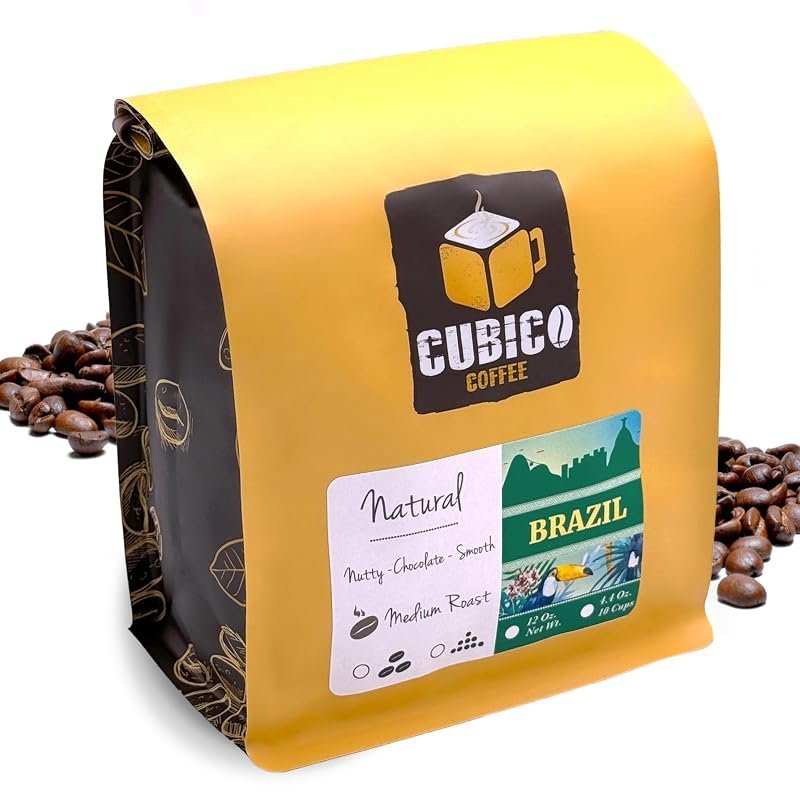
Cubico Coffee Brazilian Santos Natural, Whole Bean
Natural-processed Brazilian Santos, hand-roasted single origin. Sweeter and rounder than a washed coffee, with the syrupy body that dry-on-the-cherry drying produces.
If you want a named farm instead of a port. This one carries an actual fazenda on the label — Fazenda Santa Barbara — which is the step up from generic Santos grading. You are paying for traceability to a specific estate rather than to a shipping terminal, and in Brazil that is usually the single most reliable upgrade available.
Fazenda Santa Barbara Brazil Santos, 12 oz
100% arabica single origin traced to a named estate rather than a port grade. Medium roast, rich cocoa and nutty notes, fresh roasted.
How to brew it
Brazilian coffee rewards a slightly coarser grind than you might reach for with an African bag. Low-acid, low-density beans extract readily, and pushing them too fine takes you past sweetness into dull and ashy rather than into brightness — there is no brightness waiting there to find. If your cup tastes muddy, go two clicks coarser before you touch anything else; the mechanics are laid out in our piece on grind size science.
Water a touch off the boil, around 200°F, and a standard 1:16 ratio works fine. This is not a coffee that demands a stopwatch.
The honest summary
Brazil will never be the origin that makes you put the cup down and stare at it. What it is, instead, is the reason your morning coffee is affordable, consistent, and available — 38 percent of the world’s supply grown on flat ground by machine, processed dry because the weather allows it, and built for body rather than fireworks. Drink it on purpose rather than by accident and it is a quietly excellent cup.